Exchange Betting on Basketball: How Back-and-Lay Markets Work
 Available in US
My introduction to exchange betting came through horse racing — like most UK punters of a certain vintage. The concept of laying a horse (betting against it) felt revolutionary after years of only being able to back selections at a traditional bookmaker. When I started applying the same principles to NBA basketball, the dynamics were different but the core advantage remained: you’re trading against other punters, not against a bookmaker’s margin, and that structural difference changes the economics of every bet.
The UK online gambling segment generated GBP 7.8 billion in GGY in the year to March 2025, and exchanges capture a slice of that market by offering an alternative to the traditional sportsbook model. For basketball bettors, exchanges provide tighter effective margins, the ability to trade positions, and access to both sides of every market. The trade-off is liquidity — and in basketball, that’s the constraint you’ll hit most often.
Backing and Laying Explained for Basketball
The first NBA game I traded on an exchange was a Knicks-Heat regular-season fixture. I backed the Knicks at 2.04 pre-game, watched them build a 12-point lead, and then laid them at 1.35 during the third quarter to guarantee a profit regardless of the final result. That round-trip — back early, lay later — felt like discovering a new dimension in sports betting. Traditional bookmakers don’t let you bet against a team; exchanges do.
Backing on an exchange works identically to betting at a bookmaker. You select a team, choose your stake, and accept the available odds. If the team wins, you collect your profit. The difference is that the odds are set by other exchange users, not by a bookmaker’s pricing model.
Laying is the inverse. When you lay a selection, you’re betting that it won’t win. On an NBA moneyline market, laying the Lakers means you profit if any other outcome occurs — in this case, the opposing team winning. Your liability is calculated as the lay odds minus one, multiplied by the backer’s stake. If someone backs the Lakers at 2.50 for GBP 10 and you lay them, your liability is GBP 15 (1.50 x 10). If the Lakers lose, you keep the GBP 10 stake. If they win, you pay out GBP 15.
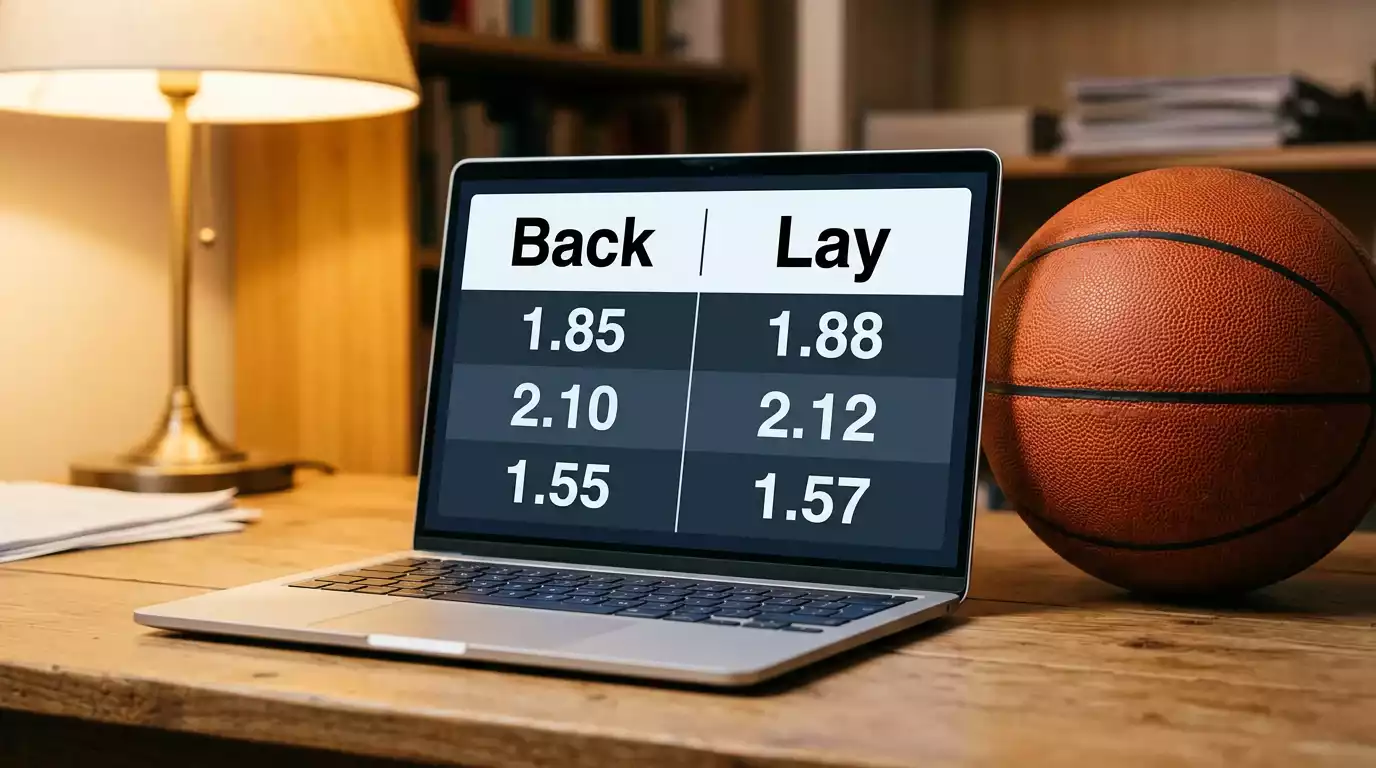
The back-lay spread — the gap between the best available back price and the best available lay price — is the market’s equivalent of the bookmaker’s margin. On liquid basketball markets, this spread can be narrower than a traditional sportsbook’s overround, which is the exchange’s primary value proposition. On illiquid markets, the spread widens, sometimes dramatically.
Exchange Commission vs Bookmaker Margin
I tracked my effective costs across a full NBA season — exchange commission versus bookmaker margin on the same games. The result was clear: on high-profile games, the exchange saved me roughly 1.5 to 2 percentage points in effective margin. On lower-profile games, the savings disappeared because the back-lay spread widened to compensate for thin liquidity.
Exchanges charge a commission on net winnings, typically between 2% and 5% depending on the platform and your trading volume. This is fundamentally different from a bookmaker’s margin, which is embedded in the odds and charged on every bet regardless of whether you win or lose. On an exchange, you only pay when you profit. Over a large sample of bets, this structure favours the bettor — you’re paying a tax on success rather than a tax on action.
The UK gambling industry’s total GGY of GBP 16.8 billion reflects the combined revenue of both traditional bookmakers and exchanges. Exchanges typically report lower GGY per pound wagered because their commission model extracts less from each transaction. For the individual bettor, this translates to better value per bet — assuming the liquidity is there to get your full stake matched at the price you want.
A practical comparison: a traditional bookmaker offers the Celtics at 1.87 and the Heat at 2.00 on a spread market. The implied probabilities sum to 103.5% — a 3.5% overround. On an exchange, you might find back prices of 1.92 (Celtics) and 2.08 (Heat), with the combined implied probability closer to 100.2% before commission. After applying a 2% commission on net winnings, your effective cost is still lower than the bookmaker’s overround on most outcomes.
For a detailed breakdown of how bookmaker margins work and how to calculate them, the vigorish and juice guide covers the mechanics of traditional overround in depth.
Trading In-Play Basketball Positions for Profit
This is where exchange betting on basketball gets genuinely interesting — and where the unique dynamics of the sport create opportunities that don’t exist in football or horse racing.
Trading means backing a selection at one price and then laying it at a shorter price (or vice versa) to lock in a profit or cut a loss. Basketball’s high-scoring, momentum-driven nature creates frequent price swings during a game. A team that falls behind by 15 points in the first quarter might see their moneyline drift from 2.00 to 4.50 — and if they close the gap to five points by half-time, the price might compress back to 2.60. If you backed them at 4.50, you can lay at 2.60 and guarantee a profit regardless of the second-half result.
NBA games are particularly suited to in-play trading because of their rhythm. Basketball has natural momentum shifts — runs of 10-0 or 15-2 are common and cause rapid price movement. Timeouts create pauses where you can assess and execute trades. Quarter breaks provide longer windows. And the sheer number of scoring possessions per game (roughly 95-105 per team) means the price is constantly updating, creating more entry and exit points than a football match generates in 90 minutes.
The constraint, again, is liquidity. In-play exchange markets on NBA games are deeper than they were five years ago, but they’re still thinner than equivalent football markets. Getting a GBP 50 or GBP 100 lay matched at your desired price might take 10 to 30 seconds, during which the game situation can change. Smaller stakes match faster; larger stakes may require you to accept a slightly worse price or risk the market moving away from you entirely.
For UK-based basketball bettors, the time zone factor adds a wrinkle. Peak exchange liquidity on NBA games coincides with peak US betting activity — roughly from 00:00 to 04:00 GMT. If you’re trading in-play at 2am, you’re competing against US-based traders who have home-court advantage in terms of wakefulness and attention. It’s a factor that’s easy to dismiss but hard to ignore after a few sessions of bleary-eyed decision-making at three in the morning.
Is there enough liquidity on exchanges for NBA betting?
Liquidity on NBA exchange markets varies significantly by game profile. High-profile matchups — nationally televised games, playoff fixtures, and games involving popular teams — attract sufficient liquidity for most recreational bettors to get their stakes matched at competitive prices. Lower-profile regular-season games between smaller-market teams may have thin liquidity, resulting in wider back-lay spreads and slower match times. Pre-match liquidity is generally better than in-play liquidity.
What is the typical exchange commission on basketball markets?
Commission rates on major UK betting exchanges typically range from 2% to 5% of net winnings per market. Some exchanges offer reduced commission rates for high-volume traders or through loyalty programmes. The commission is only charged when you make a net profit on a market — if you lose, you pay no commission.
Can you lay a bet on an NBA game from the UK?
Yes. UK-based punters can lay selections on NBA games through UKGC-licensed betting exchanges. Laying means you are betting against a specific outcome — if you lay the Lakers, you profit when the Lakers lose. Your liability is determined by the lay odds and the backer’s stake. All major UK exchanges offer NBA markets, with coverage spanning the regular season and playoffs.
Written by the editors at Basketball Betting Terms.