Same Game Parlay in Basketball: SGPs, Bet Builders, and Correlated Legs
 Available in US
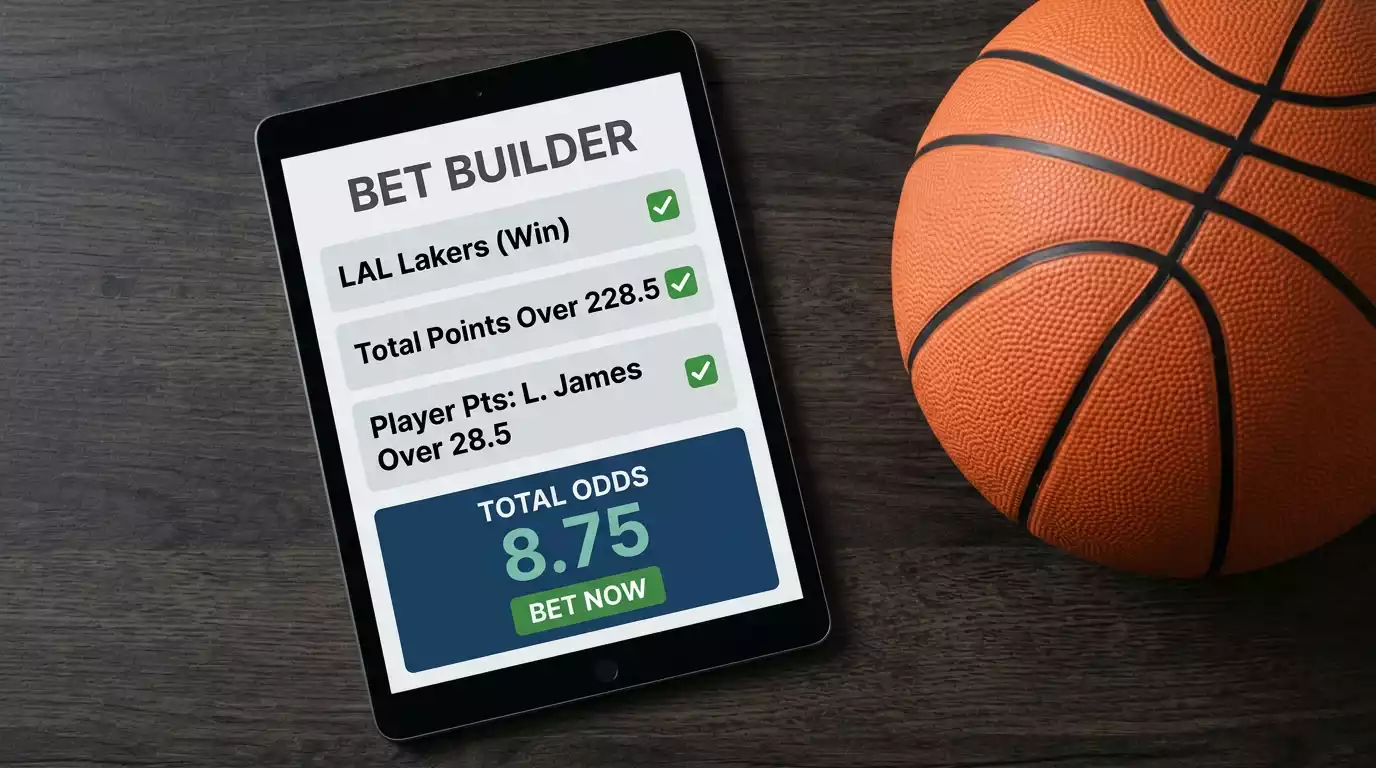
The same game parlay is the most aggressively marketed product in sports betting right now, and I say that without a trace of exaggeration. Every major sportsbook — UK and international — pushes SGPs through pop-ups, notifications, social media, and promotional emails. There’s a reason for that: they’re enormously profitable for the operator. The question is whether they can ever be profitable for you, and the honest answer requires understanding exactly how they’re built, priced, and where the house edge hides.
I’ve placed hundreds of SGPs across NBA seasons since the product launched in the UK market. My overall record on them is worse than my record on single bets, and that’s not a coincidence — it’s a structural feature of the product. Still, there are scenarios where the SGP format genuinely makes sense, and I’ll walk through those alongside the traps.
How Same Game Parlays Are Priced
Last January, I built a same game parlay on a Celtics-Bucks game: Celtics moneyline, Jayson Tatum over 27.5 points, and the game total over 222.5. Each leg independently seemed reasonable. But when I looked at the combined SGP price offered by the sportsbook, it was lower than what I’d have gotten by simply multiplying the three individual decimal odds together. That gap is where the bookmaker makes its money.
Traditional parlays multiply the odds of independent events. If three legs are priced at 1.85, 1.90, and 1.87 individually, the parlay price is 1.85 x 1.90 x 1.87 = 6.57 in decimal. But selections within a single game aren’t independent — they’re correlated. If the Celtics win, Tatum is more likely to have scored well. If the game total goes over, both teams are scoring heavily, which supports the Celtics’ high-scoring offence.
Bookmakers account for these correlations by adjusting the combined price downward. The exact methodology varies by operator and is proprietary, but the principle is consistent: positively correlated legs produce a lower SGP price than their independent multiplication would suggest. The operator’s correlation model estimates how much the outcomes overlap and reduces the combined odds accordingly — plus adds a margin on top.
The NBA partnered with FanDuel in 2024 to share real-time player-tracking data, enabling granular markets like “next player to score” and “total points in the next two minutes.” This technology directly feeds SGP pricing models. The richer the data, the more precisely the bookmaker can estimate correlations — and the tighter they can price the SGP without leaving value for the punter. Basketball’s data revolution has, paradoxically, made SGPs harder to beat even as it’s made them more popular.
From the bookmaker’s perspective, SGPs carry higher margins than standard parlays because the correlation adjustment is opaque to the customer. You can calculate the overround on a simple moneyline market in seconds. On an SGP, you’d need access to the operator’s correlation matrix to know the true implied probability — information they don’t share. That asymmetry is the product’s core commercial advantage.
Correlated Legs and Why They Reduce Your Edge
Correlation is the concept that makes or breaks SGP strategy, and I find that most punters either ignore it entirely or understand it backwards.
Positive correlation means two outcomes tend to happen together. If a team wins by a large margin, the favourite’s star player probably scored well, and the game total might lean over (because the favourite ran up the score) or under (because the opponent collapsed). The direction of the correlation depends on the specific legs you combine, and this is where it gets genuinely complex.
Here’s an example that trips people up. Suppose you combine “Team A to win” with “Team A over 115.5 team total.” These are positively correlated — winning teams tend to score more. The bookmaker accounts for this by offering you less than the independent multiplication of those two prices. You’re effectively paying a premium for a correlation the market has already priced in.
Negative correlation can work in your favour, but it’s harder to find and exploit. If you combine “Team A to win” with “under 210.5 total,” you’re betting on a scenario where Team A wins a low-scoring game — their defence dominates. These two legs have weaker positive correlation (or even mild negative correlation in some contexts), and the SGP pricing model may not discount them as heavily. The potential edge, if it exists, sits in finding leg combinations where the bookmaker’s correlation estimate is less accurate.
Basketball accounts for 15 to 18% of global sports betting activity, and the share of that volume flowing through SGP-type products has grown rapidly. The irony is that the product’s popularity among recreational punters — attracted by the potential for large returns from small stakes — is precisely what funds the bookmaker’s ability to invest in more sophisticated correlation models that make the product harder to beat.
My rule of thumb: if every leg of your SGP “makes sense” together and tells a coherent narrative (the favourite wins big, their star goes off, the total sails over), the bookmaker has already priced that narrative in. The SGPs with potential value are the ones that combine legs with less obvious relationships, where the correlation is ambiguous and the pricing model is less confident.
UK Bet Builders vs American SGPs
When I first encountered the term “bet builder” on a UK sportsbook, I assumed it was functionally identical to the American SGP. It is, mostly — but the branding difference reflects a genuine divergence in how the product is presented and, in some cases, how the legs are priced.
UK operators label the product as a “bet builder” or “build a bet” feature. The interface typically lets you select multiple outcomes from a single game — match result, player props, totals, quarter results — and see the combined price update in real time as you add or remove legs. American operators use the term “same game parlay” and offer a similar interface, though the available leg types sometimes differ between US and UK versions of the same operator’s platform.
One meaningful difference is regulatory. UK-facing bet builders must comply with UKGC requirements around transparency and fair pricing. The Gambling Commission doesn’t mandate a maximum margin on SGP-style products, but it does require that the terms of the bet are clearly communicated before the punter confirms. In practice, this means UK bet builder interfaces tend to show the potential return prominently and allow you to adjust legs easily before confirmation.
The selection range on UK bet builders for NBA games has expanded significantly. Five years ago, you might have had access to match result, handicap, and total. Today, most major UK operators offer player props (points, rebounds, assists), team props (first to 20, quarter winners), and game props (highest-scoring half, overtime yes/no) as available legs in the bet builder. The depth still trails what US-facing operators offer — particularly on micro-markets and next-play props — but the gap is narrowing.
For UK punters building SGPs on NBA games, the broader parlay and accumulator guide covers how multi-leg bets work across different game types, including the mathematical framework for assessing whether the combined price represents genuine value or just an exciting number.
Why are same game parlay odds lower than a standard accumulator?
Standard accumulators combine selections from different games, where the outcomes are independent. Same game parlays combine selections from a single game, where the outcomes are correlated. Bookmakers reduce the combined SGP price to account for that correlation — if one leg wins, the others become more likely to win too, so the fair combined price is lower than what independent multiplication would produce.
Can you cash out a same game parlay early?
Most major UK bookmakers offer cash out on same game parlays, though availability can be suspended during key in-game moments or when odds are volatile. The cash-out value reflects the current probability of your remaining legs winning, minus a margin. Cash-out on SGPs tends to be less generous than on standard accumulators because the correlation adjustments make real-time pricing more complex.
Which UK bookmakers offer bet builders for NBA games?
All major UKGC-licensed sportsbooks offer bet builder functionality on NBA games, including match result, player props, and totals as available legs. The depth of available selections varies between operators — some offer 20 or more leg options per game, while others provide a more limited menu. Coverage is strongest for nationally televised and playoff games.
Published by the Basketball Betting Terms team.