Basketball Odds Explained: Three Formats Every UK Punter Must Know
 Available in US
Table of Contents

Three numbers, same bet, completely different appearance. The first time I compared NBA odds across a UK bookmaker, a European exchange, and an American sportsbook, I stared at 5/4, 2.25, and +125 — all representing the identical payout — and thought the industry was deliberately trying to confuse people. Nine years later, I can convert between the three in my head while watching a game, and I want to get you to that point too.
The UK gambling industry generated gross gambling yield of 16.8 billion pounds in the year to March 2025, with the online segment contributing 7.8 billion. A growing share of that online action lands on basketball, particularly the NBA. Yet most of the analytical content, line-movement data, and sharp commentary around basketball betting is published in American odds. If you cannot read all three formats fluently, you are either locked out of that intelligence or prone to misinterpreting it.
This guide covers each format in depth, gives you the conversion formulas that actually stick, and shows you how to extract the hidden number that matters most: implied probability. Everything is illustrated with basketball examples, not football or horse racing — because the numbers behave differently when the standard vig structure is -110 on both sides of a spread rather than the wider margins you see in niche markets.
Fractional Odds: The UK Standard
I grew up with fractional odds. Horse racing at Cheltenham, Saturday accumulators on the Premier League — everything was 5/1, 7/2, 4/9. When I started betting on basketball, fractional odds felt natural but occasionally awkward, because basketball lines produce fractions that are harder to parse at a glance.
Fractional odds express your profit relative to your stake. At 5/1, you profit five pounds for every one pound staked. At 4/9, you profit four pounds for every nine staked — the number on the right is larger, so this is an odds-on price, meaning the implied probability exceeds 50 percent. The total return is always the profit plus your original stake.
In basketball, you will most commonly see fractional odds around the 10/11 to evens range on spread bets, because the standard pricing on both sides of a spread translates to approximately 10/11. That is tighter than most football handicap markets and much tighter than horse racing, where the bookmaker’s margin can stretch into double digits. A 10/11 price means you stake 11 pounds to profit 10, giving you a total return of 21 pounds. Straightforward enough.
Where fractional odds become unwieldy is on moneylines for heavy favourites or large underdogs. An NBA underdog priced at +350 in American odds is 7/2 in fractional — clean and simple. But a favourite at -180 becomes 5/9, and -275 becomes 4/11. These fractions are not immediately intuitive, which is why many UK punters who bet heavily on basketball switch their display to decimal. The information is identical; the presentation is just easier to compare when you are scanning ten games at once.
If you prefer fractional odds and do not want to switch, I recommend memorising a short reference table for the prices you encounter most often on basketball spreads: 10/11 (standard spread price), 5/6 (slightly juiced), evens (pick ’em), 11/10 (slight underdog), and 6/5 (mild underdog). Those five cover roughly 80 percent of the spread prices you will see on NBA games at UK bookmakers.
Moneyline fractional odds vary more widely. A moderate NBA favourite might sit at 4/7, while a top-seed hosting a bottom-feeder in the playoffs could be priced as short as 1/6. At the other end, a significant underdog’s fractional price — 3/1, 7/2, 5/1 — is where the format shines, because the profit-to-stake ratio is immediately obvious. Three to one means three pounds profit for every pound risked. No calculator required, no mental arithmetic. For these larger prices, fractional odds are arguably the most intuitive format of the three.
Decimal Odds: The European and Exchange Format
Decimal odds are the format I now use for all my analysis. Not because they are inherently superior, but because they make comparison instant. Around 8 percent of UK adults participate in online sports betting in any given four-week period, and a growing number of those punters toggle their bookmaker’s display to decimal for exactly this reason — one number tells you everything you need to know.
The decimal figure represents your total return per pound staked, including the stake itself. At decimal odds of 2.00, a one-pound bet returns two pounds — one pound profit plus your original pound. At 1.91, a one-pound bet returns 1.91 pounds — 91 pence profit. At 3.50, a one-pound bet returns 3.50 pounds — 2.50 pounds profit.
The beauty of decimal odds for basketball is speed. When you are comparing the same NBA spread across three bookmakers, the higher decimal number is always the better price. No mental gymnastics, no flipping numerators and denominators. If one site offers the Celtics -5.5 at 1.91, another at 1.93, and a third at 1.87, you know immediately that the 1.93 price is the best deal. Over a season of 200+ bets, consistently taking the best available price adds percentage points to your ROI.
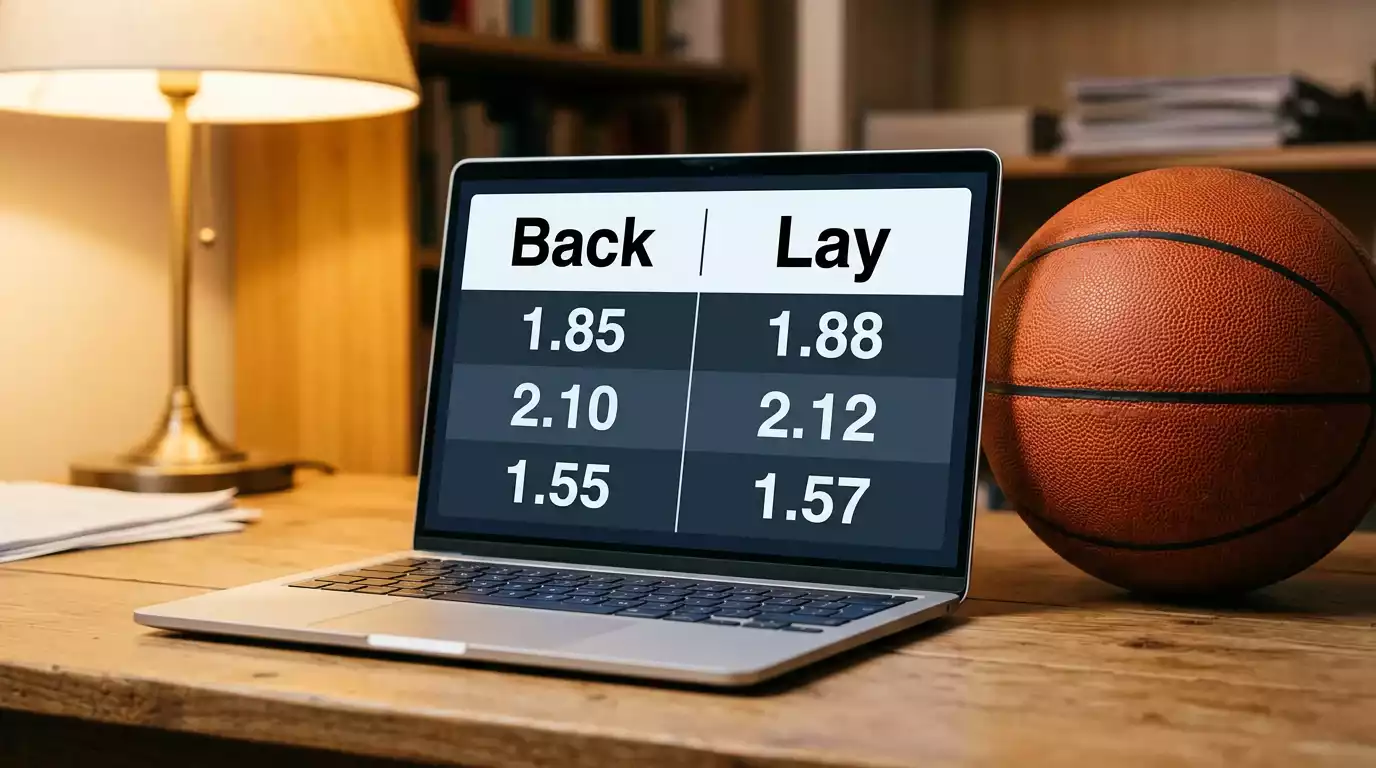
Decimal odds are also the native format on betting exchanges, which are popular in the UK for horse racing and football but underused for basketball. On an exchange, you set or accept odds in decimal form, and the lack of a traditional bookmaker margin means the prices tend to sit closer to 2.00 on each side of a spread rather than the 1.91 you see at fixed-odds bookmakers. That difference — 2.00 versus 1.91 — represents the entire gap between a zero-margin market and a standard 4.5 percent overround.
One technical note: decimal odds below 2.00 indicate an odds-on selection (implied probability above 50 percent), and odds above 2.00 indicate an odds-against selection. Exactly 2.00 is a coin flip — equal probability, no margin. In practice, you will never see true 2.00 on both sides of a basketball spread because the bookmaker always bakes in a cut. Recognising where the decimal number falls relative to that 2.00 midpoint is a quick sanity check every time you look at a line.
American Odds: Reading Plus and Minus Lines
American odds confused me for years, and I suspect they confuse most UK punters who encounter them for the first time on a US-oriented analytics site. The system splits into two halves — positive and negative — and each half uses different maths. Once you get past that initial friction, though, the format reveals something the other two do not: the magnitude of the favourite-underdog gap is visible at a glance.
Negative American odds tell you how much you need to stake to win 100 units. At -110, you stake 110 to win 100. At -200, you stake 200 to win 100. The larger the negative number, the heavier the favourite. Positive American odds tell you how much you win on a 100-unit stake. At +150, a 100-unit bet returns 150 profit. At +300, it returns 300. The larger the positive number, the bigger the underdog.
The -110/-110 structure is the default on basketball spreads and totals in the US market. It translates to 1.91/1.91 decimal or 10/11 each side, and the combined overround is approximately 4.5 percent. Americans legally wagered $166.94 billion on sport in 2025, and the vast majority of that NBA volume was priced with this exact -110 baseline. When you are reading line-movement analysis from an American source, every number is anchored to -110. If the line moves to -115 on one side, that tells you the bookmaker is extracting more juice from bettors on that outcome, making it less attractive.
For UK punters, the practical takeaway is simple: learn to read -110 as “standard pricing” and everything else as a deviation from that baseline. If the American odds on one side of a spread drift to -105, that is a favourable price — equivalent to 1.95 decimal, better than the 1.91 standard. If they stretch to -120, that is an expensive price — equivalent to 1.83 decimal. You do not need to calculate in American odds; you just need to recognise when a US source is flagging value or warning you off a line, and then translate it into your preferred format.
Moneyline American odds on basketball games can swing dramatically. A top-tier NBA side at home against a rebuilding team might be listed at -600 (1.17 decimal), while the underdog sits at +450 (5.50 decimal). The American format makes that gap viscerally obvious — you see -600 and immediately sense the weight of the favourite. In decimal, 1.17 looks almost flat and innocuous. That psychological transparency is the one genuine advantage of American odds: they communicate risk magnitude faster than any other format, even if the maths behind them is less intuitive.
How to Convert Between All Three Formats
I used to keep a cheat sheet taped to my monitor. Then I memorised the formulas, and the cheat sheet became unnecessary within a week. Here are the conversions I use every day, written out step by step so you can drill them until they become second nature.
American to Decimal: if the American odds are negative, the formula is (100 / absolute value) + 1. So -110 becomes (100 / 110) + 1 = 1.909, rounded to 1.91. If positive, it is (American odds / 100) + 1. So +150 becomes (150 / 100) + 1 = 2.50.
Decimal to Fractional: subtract 1 from the decimal, then express the result as a fraction. Decimal 2.50 minus 1 equals 1.50, which is 3/2. Decimal 1.91 minus 1 equals 0.909, which approximates 10/11. Some conversions do not simplify neatly — decimal 1.87 minus 1 equals 0.87, which is 87/100. In practice, most bookmakers round to the nearest common fraction, so 1.87 might display as 6/7 or 13/15 depending on the platform.
Fractional to Decimal: divide the first number by the second and add 1. So 5/4 becomes (5 / 4) + 1 = 2.25. And 10/11 becomes (10 / 11) + 1 = 1.909.
Decimal to American: if the decimal is 2.00 or higher, multiply (decimal minus 1) by 100. So 2.50 becomes (2.50 – 1) x 100 = +150. If the decimal is below 2.00, divide -100 by (decimal minus 1). So 1.91 becomes -100 / (1.91 – 1) = -100 / 0.91 = -109.89, rounded to -110.
The one I use most frequently is American to Decimal, because that is the direction of translation when I am reading US analysis and converting it into numbers my UK betting accounts actually show. I recommend picking the two conversions most relevant to your workflow and practising them with real lines until you no longer need to think about it. Five minutes a day for a week, and you will have it cold.
A worked example ties it together. You read on a US analytics site that the Milwaukee Bucks are -140 to beat the Miami Heat. What does that look like in UK terms? American to Decimal: (100 / 140) + 1 = 1.714, which you round to 1.71. Decimal to Fractional: 1.71 – 1 = 0.71, which approximates 5/7. So -140 American equals 1.71 decimal equals 5/7 fractional. The Heat, listed at +120, convert to (120 / 100) + 1 = 2.20 decimal, or 6/5 fractional. Those are the prices your UK bookmaker would show if the margin is equivalent. If your bookmaker offers the Bucks at 1.67 instead of 1.71, you know immediately that their margin on this line is wider than what the US market offers.
From Odds to Implied Probability
Every set of odds contains a hidden number that most casual bettors never extract: the implied probability. This is the percentage chance the bookmaker’s price assigns to an outcome, and comparing it against your own assessment is the entire foundation of profitable betting.
The formula is straightforward. For decimal odds, divide 1 by the decimal number and multiply by 100. Decimal 1.91 gives you (1 / 1.91) x 100 = 52.36 percent. Decimal 2.50 gives you (1 / 2.50) x 100 = 40 percent. For fractional odds, divide the denominator by the sum of numerator and denominator, then multiply by 100. At 10/11, that is 11 / (10 + 11) x 100 = 52.38 percent.
Here is where it gets interesting. If both sides of a basketball spread are priced at 1.91, the implied probability of each side is 52.36 percent. Add them together: 52.36 + 52.36 = 104.72 percent. That extra 4.72 percent above 100 is the overround — the bookmaker’s built-in margin. It means the sum of probabilities always exceeds 100 percent, and the difference is the tax you pay for the privilege of placing bets.
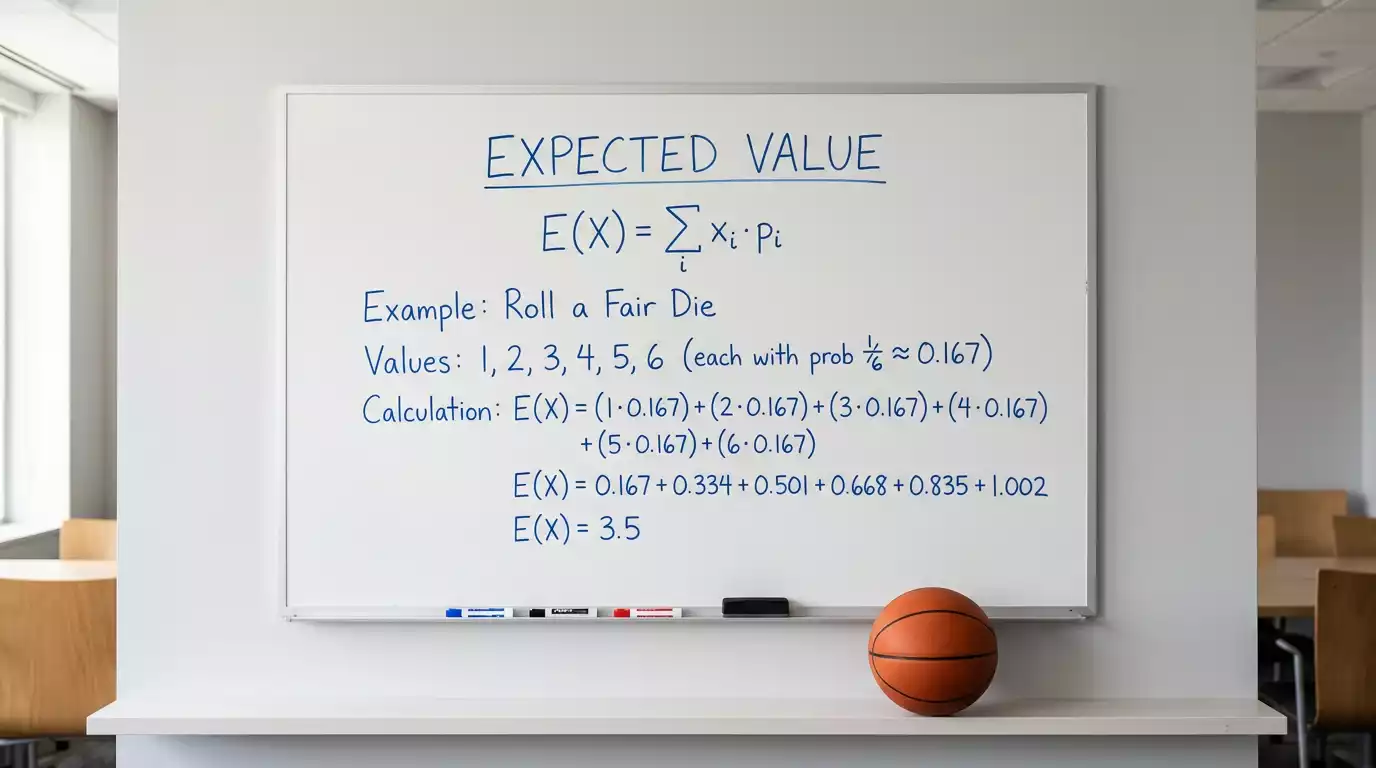
Why does this matter in practice? Because when you calculate implied probability and compare it to your own estimate of the true probability, you identify value. If you believe the Celtics have a 58 percent chance of covering -5.5, and the bookmaker’s implied probability is 52.4 percent, that is a value bet — you believe the true chance exceeds the price. If your model says 50 percent and the implied is 52.4 percent, the bet is negative expected value and you should pass. This framework applies to every basketball market: spreads, totals, moneylines, props, futures. The format of the odds is irrelevant; the implied probability beneath them is everything.
I run this calculation on every bet I place. It takes about five seconds once the formula is automatic, and it has saved me from hundreds of bad wagers over the years. The most common mistake I see is punters comparing decimal odds across bookmakers without first converting to implied probability. A price of 2.10 on one site and 2.05 on another looks like a small difference — just five pence per pound staked. But in implied probability terms, 2.10 is 47.6 percent and 2.05 is 48.8 percent. If your model puts the true probability at 48 percent, the first bet has positive expected value and the second does not. That five-pence gap is the difference between a winning bet and a losing one.
For moneyline bets on heavy favourites, implied probability reveals the true cost of “safe” bets. An NBA favourite at 1.15 decimal odds carries an implied probability of 87 percent. That sounds comfortable until you consider that the team’s actual win rate in that scenario might be 85 percent. The 2 percentage point gap is the bookmaker’s margin eating into what looks like a sure thing. Over a full season, betting odds-on favourites at inflated implied probabilities is one of the most reliable ways to slowly bleed money.
Understanding the Overround: Reading Margins in Different Odds Formats
Grainne Hurst, the CEO of the Betting and Gaming Council, once described how friction in the betting process pushes customers toward unregulated markets where there are no safeguards at all. The overround is a different kind of friction — a mathematical one — and understanding it protects you from overpaying without realising it.
The overround, also called the margin or the vig, is the percentage by which the total implied probabilities exceed 100. On a two-way basketball spread priced at 1.91/1.91, the overround is 4.72 percent. On a three-way moneyline (home win, away win, draw — though draws do not happen in basketball after overtime), the overround would be higher because there are more outcomes to price in. For standard NBA markets, overrounds typically sit between 4 and 6 percent at major UK bookmakers, and between 2 and 3 percent on exchanges.
Calculating the overround in decimal odds is the fastest method. Take the two (or more) prices, convert each to implied probability by dividing 1 by the decimal, sum them, subtract 100, and you have the overround. If one side of a spread is 1.91 and the other is 1.91, the maths is (1/1.91 + 1/1.91) x 100 – 100 = 4.72 percent. If the prices are 1.87 and 1.95, it becomes (1/1.87 + 1/1.95) x 100 – 100 = 4.78 percent. That second scenario has a nearly identical total margin, but the distribution is lopsided — the bookmaker is charging more on one side.
For a detailed walkthrough of how the vig affects your long-term returns and strategies for reducing its impact, I have written a separate piece on vigorish and juice in basketball betting that goes much deeper into the maths.
The practical habit I recommend: before placing any basketball bet, calculate the overround on that specific market. If it exceeds 6 percent, the bookmaker is taking a large cut and you need stronger conviction to justify the bet. If it is below 4 percent, you are getting relatively fair pricing. On exchanges, you might find overrounds below 2 percent on popular NBA games — that is as close to a fair market as retail bettors can access.
Frequently Asked Questions
Which odds format is best for calculating payouts quickly?
Decimal odds are the fastest for payout calculation. Multiply your stake by the decimal number and you have your total return instantly. A 10-pound bet at 2.25 returns 22.50. No division, no separate profit calculation — one multiplication gives you the answer.
Why do UK bookmakers default to fractional odds for basketball?
UK bookmakers default to fractional odds across all sports because that is the traditional format British punters grew up with, particularly through horse racing. Basketball is no exception. Most platforms allow you to switch to decimal or American in your account settings, and I recommend doing so if you bet on basketball regularly.
How do you calculate the bookmaker’s margin from decimal odds?
Convert each decimal price to implied probability by dividing 1 by the decimal number. Add all the implied probabilities together and subtract 100. The result is the overround, expressed as a percentage. For a standard basketball spread at 1.91 on both sides, the margin is approximately 4.72 percent.
What does odds-on mean in basketball betting?
Odds-on means the implied probability of the outcome exceeds 50 percent. In fractional terms, the first number is smaller than the second (like 4/9). In decimal terms, the price is below 2.00. It indicates a strong favourite — you risk more than you stand to profit, but the selection is expected to win more often than not.
Written by the editors at Basketball Betting Terms.