Reverse Line Movement in NBA Betting: Spotting Sharp Money Signals
 Available in US
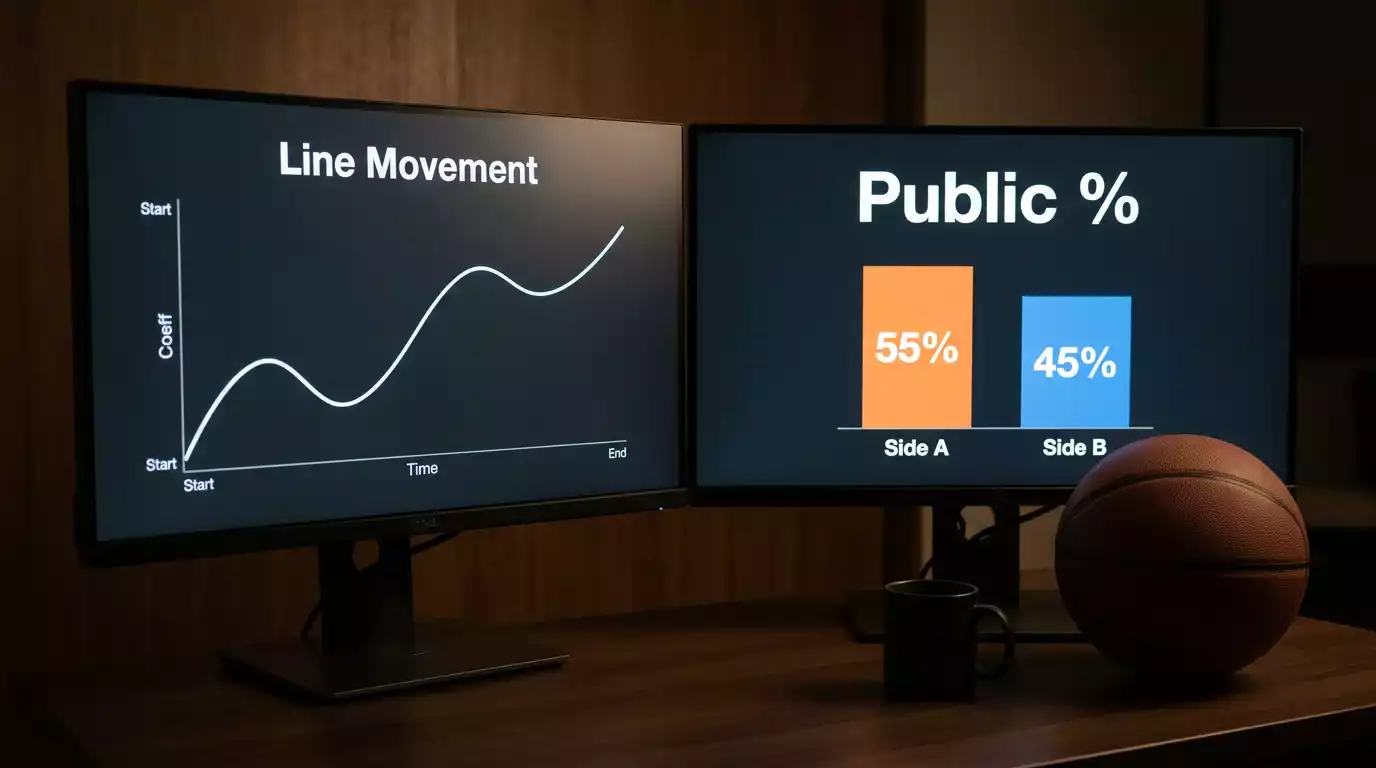
There’s a moment in every basketball bettor’s education when the numbers stop making sense. You check the betting percentages on a Lakers-Nuggets game, see that 72% of spread bets are on the Lakers, and expect the line to move in the Lakers’ direction to balance exposure. Instead, the line moves the other way — the Nuggets’ spread shortens. The public is pounding one side, and the bookmaker is actively making the other side more attractive. That contradiction has a name: reverse line movement. And understanding it gave me a genuine edge when I first encountered it.
I’ve been tracking line movement patterns on NBA games since 2019, and reverse line movement remains one of the most reliable signals that sharp money is involved in a game. It’s not foolproof — nothing in betting is — but it’s a measurable, repeatable indicator that the market’s smartest participants disagree with the betting public.
What Reverse Line Movement Looks Like
The first time I spotted genuine RLM, I almost dismissed it. The game was a Tuesday night NBA fixture — Charlotte Hornets at Toronto Raptors. Roughly 68% of bets were on the Raptors -5.5, but over the course of three hours, the line moved from -5.5 to -4.5 and then to -4. The public was backing Toronto, but the line was drifting towards Charlotte. Something didn’t add up — unless you understood who was betting, not just how many bets were being placed.
Bookmakers don’t move lines based solely on the number of bets. They move lines based on money. And in sports betting, a single six-figure wager from a sharp syndicate carries more weight than a thousand small recreational bets. When 70% of tickets are on one side but the line moves the other way, it means the 30% minority is wagering significantly more money per bet. Those are the sharps — professional or semi-professional bettors whose action bookmakers respect and respond to.
The movement pattern is distinct from normal line drift. A normal movement follows the public: heavy action on the favourite pushes the spread wider, reducing the bookmaker’s risk on the popular side. Reverse line movement contradicts the public: the line moves toward the less popular side, increasing the bookmaker’s theoretical exposure to the majority of tickets. Bookmakers accept this exposure because they trust the sharp money’s assessment more than the public’s sentiment.
Reverse line movement typically occurs in the two to four hours before tip-off, when sharp bettors place their action after analysing final injury reports, lineup confirmations, and their own proprietary models. Earlier line moves — those in the 12 to 24 hours before the game — are often driven by different factors, including bookmaker adjustments to their own models rather than incoming sharp money.
Public Money vs Sharp Money in Basketball Markets
I spent a season trying to follow the public on NBA games — betting the popular side every time — to see if consensus had any predictive power. It didn’t. My results were almost exactly break-even before the vig, which means I lost the cost of the juice on every bet. The public, in aggregate, is roughly right about which team is better but consistently wrong about the margin — which is exactly the information the spread prices.
The distinction between public and sharp money is fundamental to reading line movement. Public bettors — sometimes called “squares” in American terminology — tend to bet favourites, popular teams, and overs. They react to recent results, media narratives, and name recognition. Their bets are smaller individually and arrive earlier in the betting cycle.
Sharp bettors — “wiseguys” or “professional money” — have a different profile entirely. They bet based on models, proprietary data, and statistical edges. Their bets are larger, arrive later, and target specific line values rather than general opinions about which team will win. When sharp money enters a market, bookmakers notice immediately because the bet size and the account history trigger internal alerts.
About 22% of American adults had an active sportsbook account in early 2025, with the proportion rising to 48% among men aged 18 to 49. That massive recreational base creates a pool of public money that sharps can exploit. When the public pushes a line in one direction based on narrative rather than analysis, it creates value on the other side — value that experienced bettors and syndicates are positioned to capture.
The asymmetry is structural. The betting public collectively represents enormous volume but limited analytical sophistication. Sharp money represents far less volume but significantly more predictive accuracy. Bookmakers calibrate their lines to the sharp money because their business model depends on setting accurate prices, not on being popular.
How to Use Reverse Line Movement in Your Betting
I incorporate RLM as one input among several, never as a standalone signal. The times I’ve blindly followed reverse line movement without confirming the thesis through my own analysis, my results have been inconsistent. When I use RLM to confirm an opinion I’ve already formed, or to flag games where my analysis might be wrong, it’s genuinely valuable.
The first practical step is accessing betting percentage data. Several free and subscription-based services track the percentage of bets and the percentage of money on each side of NBA markets. The signal you’re looking for is a divergence: high percentage of bets on one side, but the line moving the other way. Not every divergence is RLM — some are caused by the bookmaker adjusting to new information rather than sharp money — but consistent divergence patterns across multiple sportsbooks strengthen the signal.
The second step is timing. RLM that occurs within four hours of tip-off is more meaningful than movements earlier in the day. Late-breaking sharp action typically reflects final-form analysis that incorporates the latest available information. Early movements might just reflect the bookmaker’s model update after releasing the opening line.
The third step is corroboration. If you’ve identified RLM on a game, check whether the movement aligns with factors you can independently verify. Has a key player been upgraded or downgraded on the injury report? Is one team on a back-to-back while the other is rested? Does the pace matchup favour one side of the total? If the sharp money’s direction aligns with identifiable analytical factors, the signal is stronger. If the RLM seems to contradict all available information, proceed with caution — it could be a middling move, a hedge, or simply noise.
For a deeper understanding of how basketball lines evolve from their opening to closing price, the closing line value guide explains why the final number matters more than any individual movement along the way.
One important caveat: bookmakers are aware that punters track RLM, and some will intentionally hold a line or move it slowly to encourage continued public action on the popular side before adjusting sharply near game time. This gamesmanship means that mid-afternoon line snapshots might not accurately reflect the true balance of money. Checking line movements across multiple operators — rather than relying on a single sportsbook’s line — reduces the risk of being misled by one operator’s positioning strategy.
Is reverse line movement always a reliable indicator?
No. Reverse line movement is one signal among many, and it produces false positives. Not every instance of RLM reflects sharp money — bookmakers sometimes adjust lines based on their own internal models or risk management strategies unrelated to incoming wagers. RLM is most reliable when it occurs close to tip-off, is confirmed across multiple sportsbooks, and aligns with identifiable analytical factors.
Where can UK punters find NBA betting percentages?
Several websites and apps track NBA betting percentages, showing the distribution of bets and money across both sides of a market. Some services are free with limited data, while subscription platforms offer real-time updates and historical archives. These tools primarily source data from US-facing sportsbooks, but the information is relevant for UK punters since the underlying NBA markets are global.
What is a steam move in basketball betting?
A steam move occurs when a line shifts rapidly and significantly in a short time, typically driven by coordinated sharp action across multiple sportsbooks simultaneously. In NBA markets, a steam move might see a spread shift by 1.5 to 2 points within minutes. Steam moves are the most aggressive form of sharp money influence and often indicate that a large syndicate has identified a significant edge on one side of the market.
Prepared by the Basketball Betting Terms editorial staff.