Closing Line Value in Basketball: Measuring Your Edge Against the Market
 Available in US
For the first three years of my basketball betting career, I judged my performance exclusively by profit and loss. Good month? I was sharp. Bad month? Variance. Then a friend who’d worked as a trader at a major sportsbook introduced me to closing line value, and it reframed everything. CLV doesn’t care whether you won or lost a specific bet. It asks a harder question: did you bet at a price that was better than where the market settled? That distinction is the single most reliable predictor of long-term betting success.
The US sports betting market processed $166.94 billion in legal wagers in 2025, and the closing lines on NBA games — shaped by the sharpest money in the world flowing through those markets — are considered among the most efficient prices in all of sports betting. Beating those lines consistently is the benchmark that separates professional-grade handicapping from recreational punting.
What Closing Line Value Means and Why It Matters
I once met a punter who’d been profitable for two seasons running and was convinced he’d cracked the code. When I asked whether he’d tracked his CLV, he looked at me blankly. Six months later, his results reverted hard — the profits had been variance, not skill. CLV would have told him that from the start.
The closing line is the final set of odds available on a market just before it closes — typically at tip-off for NBA games. It represents the market’s most informed estimate of the true probabilities, because it incorporates all available information: late injury news, sharp money, lineup confirmations, public betting patterns, and the bookmaker’s own risk management adjustments.
Closing line value is the difference between the odds you received when you placed your bet and the closing odds. If you bet the Celtics at 1.95 and the closing line on the same side was 1.87, you got a better price than the market’s final assessment. That’s positive CLV. If you bet at 1.85 and the line closed at 1.92, you got a worse price — negative CLV.
The reason CLV matters more than short-term results is that basketball outcomes involve enormous variance. A punter with genuine skill — who consistently identifies value before the market corrects — can still lose money over a 200-bet sample due to bad luck. Conversely, a punter with no edge can profit over the same sample through good fortune. CLV strips out the noise of individual results and measures the quality of your decisions.
Research across professional betting circles consistently shows that bettors with positive CLV over a large sample are profitable over the long term, and bettors with negative CLV are not — regardless of their short-term results. It’s the closest thing to a universal truth in sports betting analytics.
How to Calculate Your CLV on Basketball Bets
The calculation itself is simple. The discipline of recording it consistently is the hard part — and I say that as someone who still occasionally forgets to log a closing line after a late-night NBA session.
For each bet, you need two numbers: the odds at which you placed the bet and the closing odds on the same selection. Convert both to implied probabilities. Your CLV is the difference between the closing implied probability and your bet’s implied probability.
A worked example: you bet the Knicks -4.5 at 1.93 decimal odds. At tip-off, the closing line on the same side is 1.85. Your implied probability: 1 / 1.93 = 51.8%. Closing implied probability: 1 / 1.85 = 54.1%. Your CLV: 54.1% – 51.8% = +2.3%. That’s strong. You got a 2.3-percentage-point better price than the market’s final word.
FanDuel and DraftKings together control roughly 75% of the US sports betting market by handle, and their closing lines on NBA games are among the sharpest available. For UK punters, comparing your bet prices against the closing lines at these operators — even if you bet elsewhere — provides the most reliable CLV benchmark. Several third-party odds-tracking websites record historical line movements and closing prices across multiple operators, making this comparison straightforward.
Track your CLV over a minimum of 300 to 500 bets before drawing conclusions. Short samples are noisy, and a handful of bets where you got lucky on timing can inflate your CLV in ways that don’t reflect genuine skill. The signal becomes clear at scale — if your average CLV is consistently positive across hundreds of bets, you’re beating the market. If it’s consistently negative, the market is beating you, even if your profit-and-loss statement says otherwise for now.
Practical Steps to Improve Your Closing Line Value
When I first started tracking CLV, mine was negative. Not by much — maybe half a percentage point on average — but consistently so. Turning that around required three specific changes to my process, and I’ll share them directly because they’re actionable for any UK punter betting on NBA games.
The first change was betting earlier. Closing lines are efficient because they’ve absorbed hours of information flow. If you can form an opinion before the market does — based on your own model, early injury intelligence, or a pattern you’ve identified — placing your bet early captures value that disappears by tip-off. I moved my primary betting window from two hours before tip-off to the moment lines opened, and my CLV improved almost immediately.
The second change was line shopping. Maintaining accounts at four UK sportsbooks means I can compare prices on the same game and take the best available number. A 0.05 improvement in decimal odds doesn’t sound like much, but across 500 bets per season, it compounds into several percentage points of CLV. The time investment — maybe two minutes per bet to check four apps — is trivial compared to the value it creates.
The third change was being more selective. I reduced my volume from roughly 10 bets per week to five or six, focusing on games where my analysis identified a clear discrepancy between the opening line and my projected outcome. Fewer bets means less vig paid, and higher conviction bets tend to produce better CLV because the edge is larger on each individual selection.
Adam Silver once wrote that sports betting should be brought out of the underground and into the sunlight where it can be appropriately monitored and regulated. That transparency has, among other things, made closing lines more accessible to ordinary punters. A decade ago, tracking CLV required insider connections or expensive data subscriptions. Today, the information is available through free or low-cost tools. The playing field is more level than it’s ever been — which means the punter who actually does the work of tracking and improving their CLV has a genuine structural advantage over the majority who don’t.
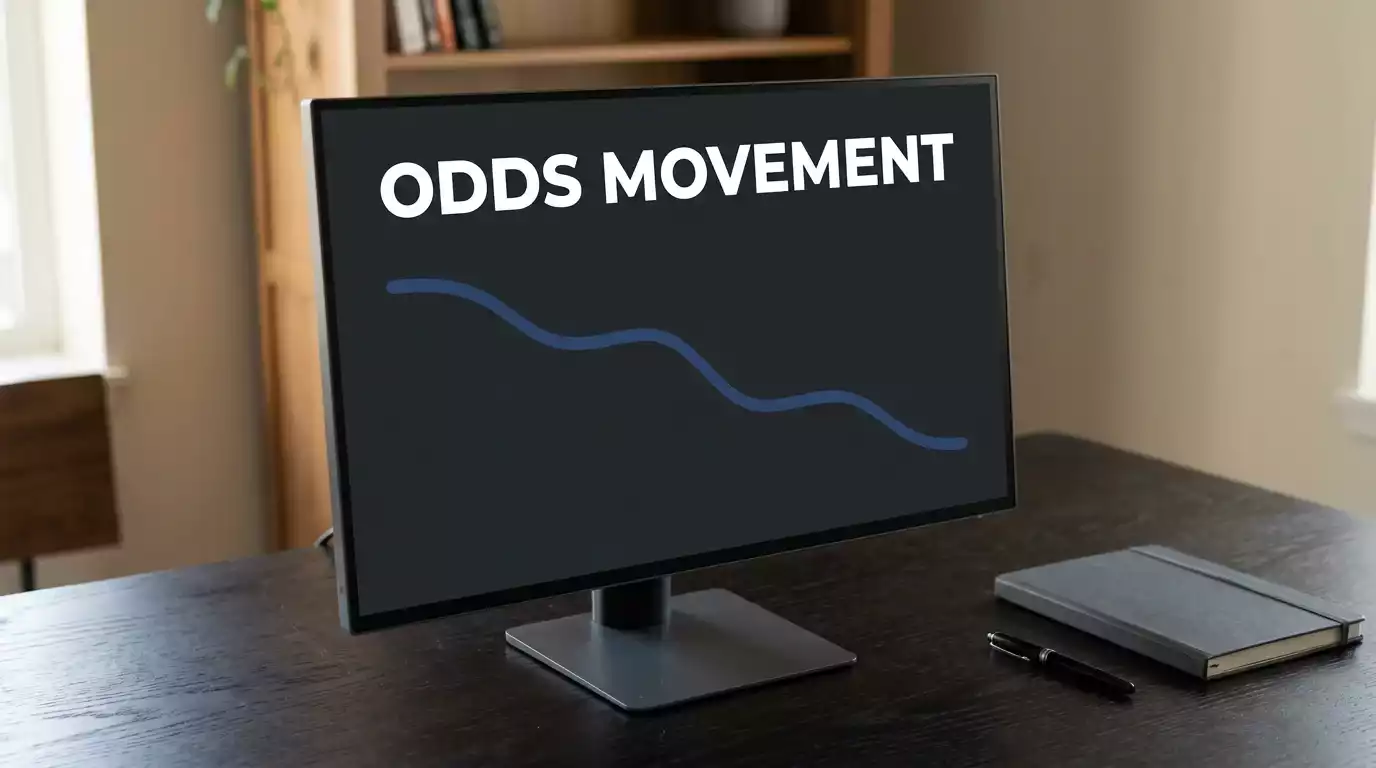
For a complementary perspective on how lines move and why, the guide to reverse line movement in NBA betting covers the mechanics of sharp money and market adjustment in detail.
Is positive CLV a guarantee of long-term profit?
Positive CLV is the strongest predictor of long-term profitability, but it is not a guarantee over any specific time period. Variance in basketball outcomes means that even a bettor with consistently positive CLV can experience losing months or quarters. Over a sample of 1,000 or more bets, however, positive CLV has historically correlated very strongly with positive returns.
How quickly do NBA closing lines become efficient?
NBA closing lines are highly efficient by tip-off, reflecting information from sharp bettors, algorithmic models, and late-breaking news. Most of the significant line movement occurs in the final two to four hours before a game, as sharp money enters the market and bookmakers adjust. Lines on high-profile games become efficient faster than those on lower-profile matchups.
Do bookmakers limit accounts with consistently high CLV?
Some bookmakers do restrict or limit accounts that consistently beat the closing line. This is more common with operators who rely on recreational volume and less common with exchanges or sharp-friendly sportsbooks. If you find your stakes being reduced, it may indicate that the bookmaker has identified your account as consistently achieving positive CLV. Maintaining accounts at multiple operators and varying your betting patterns can mitigate this, though no approach eliminates the risk entirely.
Written by the editors at Basketball Betting Terms.