Basketball Odds Boosts: How Enhanced Prices Work and When They Have Value
 Available in US
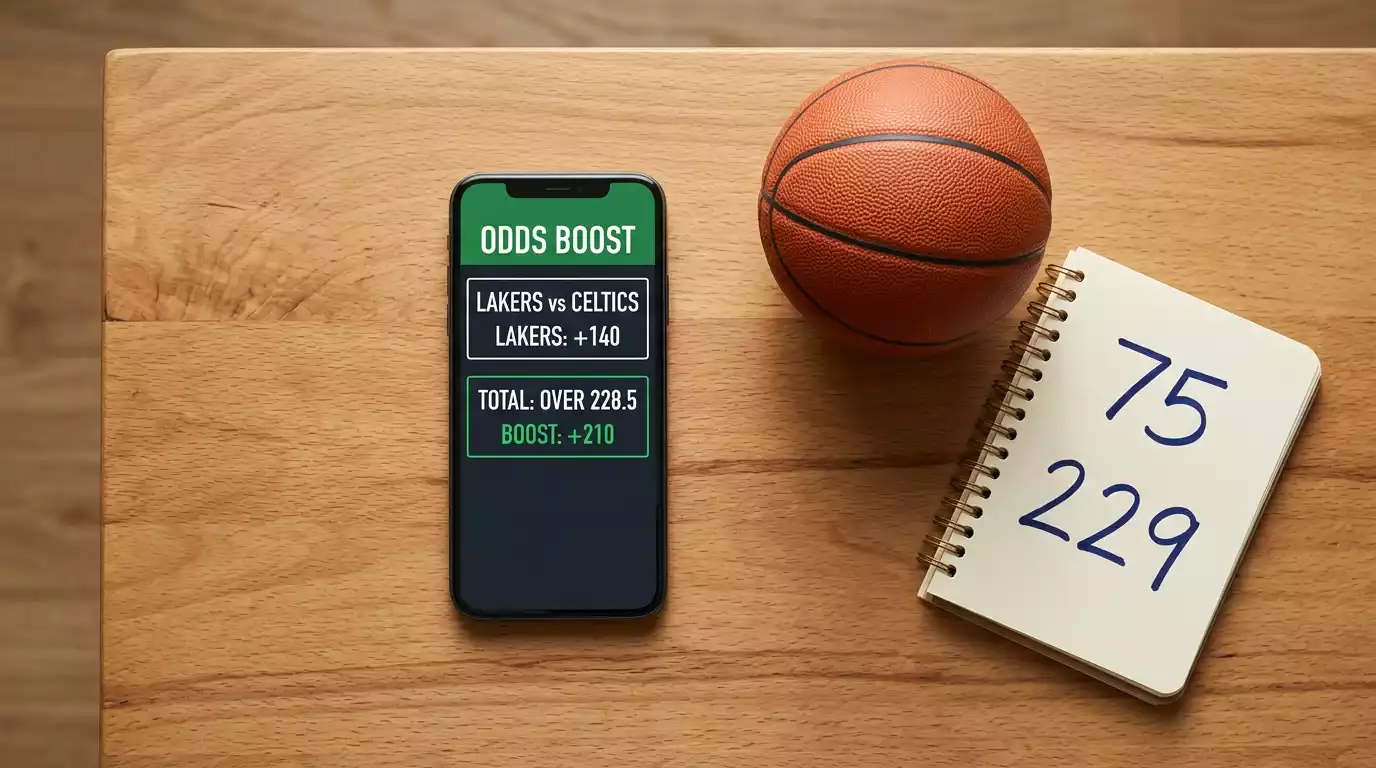
Every Friday evening during the NBA season, my phone lights up with notifications: “Boosted odds on tonight’s Lakers game!” “Enhanced treble: three NBA favourites at 8/1!” “Odds boost special: Tatum to score 30+ at 5.00!” The promotions are relentless, and they’re designed to do one thing — get you betting on games you might otherwise ignore, at prices that look more generous than they actually are. I’ve taken hundreds of odds boosts over the years. Some have been genuinely good value. Most have not. The difference comes down to a calculation most punters never bother to do.
The UK online gambling market generated GBP 7.8 billion in GGY in the year to March 2025, and odds boosts are one of the primary marketing tools operators use to drive that volume. Understanding how they work — and more importantly, how to evaluate whether they represent real value — is a practical skill that saves money over a full NBA season.
How Bookmakers Set and Promote Odds Boosts
A former sportsbook marketing manager once told me something that reframed how I view odds boosts: “The boost isn’t the product. The customer’s attention is the product.” That distinction matters, because it reveals the commercial logic behind every enhanced price you see.
Odds boosts are selectively enhanced prices offered by the bookmaker on specific selections or combinations. The operator takes a market where the standard price might be 3.50 in decimal and boosts it to 4.50 or 5.00 — a visibly higher number that catches the punter’s eye. The boost is typically capped at a maximum stake (often GBP 10 to GBP 50) and available for a limited time.
The bookmaker funds the boost from its marketing budget, treating the enhanced odds as a customer acquisition or retention cost. The calculation is straightforward: if 10,000 customers take a GBP 10 boost at 5.00 that the bookmaker values at 3.50, the expected cost is the difference in implied probability multiplied by the volume — essentially, the operator is subsidising a portion of the expected payout to attract eyeballs and betting activity.
The promotion’s real purpose isn’t the single boosted bet. It’s everything that happens around it. A punter who logs in to take an NBA odds boost will often browse other markets, place additional bets at standard prices, and deposit more funds to cover those bets. The boost is a loss leader — the bookmaker expects to lose money on the promoted selection and recover it through the customer’s wider betting activity.
Boosts are most commonly offered on high-profile NBA games (nationally televised, playoffs, Christmas Day), popular teams (Lakers, Celtics, Warriors), and narrative-driven selections (“LeBron to record a triple-double”). The selections are chosen for their marketing appeal, not for their betting value. This isn’t a conspiracy — it’s commercial logic. The more exciting the proposition sounds, the more customers engage, and the more secondary activity the boost generates.
How to Tell If an Odds Boost Has Real Value
I evaluate every odds boost through the same lens I’d use for any other bet: does the offered price exceed my estimate of the fair price? The fact that it’s “boosted” is irrelevant to the maths. A bad bet at boosted odds is still a bad bet.
The process is simple. First, check the unboosted price — the standard odds on the same selection at the same sportsbook. Then check the same selection at two or three other bookmakers to establish a market consensus. If the boosted price is higher than the best available standard price across the market, the boost has at least some genuine value. If the boosted price is still below what another bookmaker offers as their standard price, the boost is marketing theatre.
For single-selection boosts, this comparison is straightforward. For accumulator boosts — “enhanced treble” or “boosted four-fold” — the assessment is harder because you need to evaluate each leg independently and then compare the combined boosted price against the independent multiplication of the best available individual odds. This takes a few minutes with a calculator, and the result often reveals that the “boost” barely exceeds what you’d get by constructing the same accumulator at the best available prices across multiple sportsbooks.
FanDuel and DraftKings together control approximately 75% of the US sports betting market by handle. Their standard lines are among the sharpest available, and they also offer frequent NBA odds boosts. When a sharp-priced operator boosts a selection above its own standard line, the genuine value is more likely to be real than when a wider-margin operator boosts a selection that was already overpriced at the standard level.
For the mathematical framework behind assessing whether any bet — boosted or standard — offers genuine positive expected value, the expected value guide for basketball betting walks through the formula and its practical application.
There is also a seasonal pattern worth tracking. Bookmakers are most aggressive with genuine value boosts at the start of the NBA season and during the playoffs, when they are competing hardest for new deposits and engagement. Mid-season boosts, particularly on mid-week games between small-market teams, tend to offer thinner value because the operator’s acquisition pressure is lower and the boost serves a retention function rather than a competitive one. I keep a simple log of every boost I evaluate, noting the boosted price, the market consensus, and the implied value gap. Over a season, patterns emerge — certain operators consistently offer better boosts than others, and certain game types attract more genuine value than the baseline.
One more test I apply: if the boosted selection requires a specific confluence of unlikely events — “Player X to score 35+ points AND his team to win by 20+” — the boost is almost certainly designed to be eye-catching rather than value-creating. The more conditions stacked into a boosted proposition, the more the bookmaker’s correlation pricing can obscure whether the enhanced odds represent genuine value. Simple single-selection boosts are easier to evaluate and more likely to contain real value than exotic multi-condition boosts.
The discipline I apply to odds boosts is the same discipline I apply to everything else: take them when the maths supports it, ignore them when it doesn’t, and never let a promotional notification override an analytical decision. Over a full NBA season, the punters who profit from boosts are the ones who treat them as another data point — not as an invitation to bet.
Are odds boosts always better than the standard price?
Not necessarily. An odds boost increases the price on a specific selection, but the boosted price may still be lower than what another bookmaker offers as their standard price on the same selection. Always compare the boosted odds against prices at other sportsbooks before assuming the boost represents genuine value. Some boosts provide real positive expected value; others are marketing promotions that look generous but don’t exceed the best available market price.
Do odds boosts count towards accumulator offers?
This varies by operator and promotion. Some bookmakers exclude boosted selections from accumulator insurance or acca bonus promotions. Others allow them. The terms and conditions of both the odds boost and the accumulator offer should be checked before constructing your bet. If a boosted selection is excluded from an acca bonus, the net value of including it may be lower than using the standard price that qualifies.
How often do UK bookmakers offer NBA odds boosts?
During the NBA season, most major UK sportsbooks offer basketball odds boosts multiple times per week — often daily on high-profile games. The frequency increases during the playoffs, All-Star Weekend, and Christmas Day games. Some operators also offer weekly or seasonal NBA boost promotions tied to specific bet types, such as boosted same game parlays or enhanced player prop prices.
Prepared by the Basketball Betting Terms editorial staff.