Basketball Point Spread Explained for UK Bettors
 Available in US
Table of Contents
- How the Point Spread Works in Basketball
- Reading the Number: What +7.5, -3, and Pick ‘Em Mean
- ATS Records and Why They Matter for Handicappers
- Why Certain Spread Numbers Appear More Often
- When to Bet the Spread Instead of the Moneyline
- Point Spreads in Decimal and Fractional Odds
- Spread Betting Mistakes to Avoid
- Frequently Asked Questions

I still remember the first NBA spread I ever placed from a London flat — Lakers minus 6.5 against the Grizzlies, back when I barely understood what that half-point meant. The bet won, but only because a garbage-time three pushed the margin to eight. I had no idea how close I came to losing on a technicality I didn’t understand. That moment made me obsess over the mechanics of point spreads, and nine years later, the spread remains the single most important concept I teach to anyone entering basketball wagering.
The basketball betting market has grown to an estimated $8.7 billion globally, with projections pushing that figure toward $18.4 billion by 2033. Basketball accounts for roughly 15 to 18 percent of global sports betting activity, and in the United States that share climbs even higher. For UK punters, the spread is the gateway to all of it — the foundation every other market builds on. Whether you are betting on the NBA, EuroLeague, or the NCAA tournament, the point spread is the line that separates sharp decisions from blind guesses.
This guide breaks down exactly how basketball spreads work, how to read the numbers, what ATS records tell you, and how to translate everything into the decimal and fractional odds formats you actually see on UK betting sites. I have spent nearly a decade dissecting these lines, and I am going to walk you through every detail that matters.
How the Point Spread Works in Basketball
A point spread is a number set by bookmakers that forces a margin of victory into the equation. Instead of simply picking which team wins, you are predicting whether a team wins by enough — or loses by less than expected. The favourite gets a negative number, the underdog gets a positive one, and the spread sits in the middle like a fulcrum balancing the action on both sides.
Here is the basic logic. Say the Boston Celtics are listed at -5.5 against the Chicago Bulls. If you back the Celtics on the spread, they need to win by six or more points for your bet to land. Back the Bulls at +5.5, and they can lose by up to five points and you still collect. The half-point eliminates any possibility of a tie — somebody wins, somebody loses.
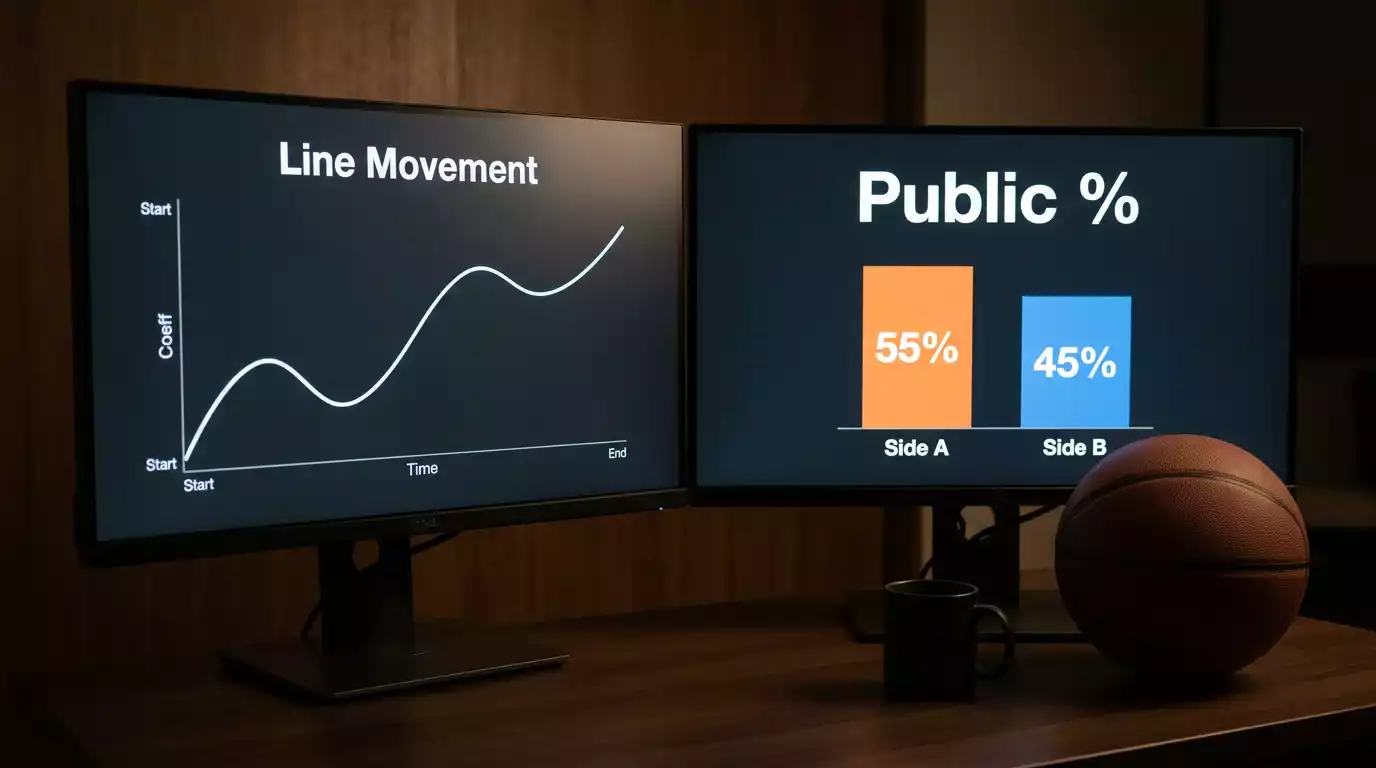
Bookmakers do not set spreads to predict the exact margin of victory. They set spreads to split opinion down the middle, attracting roughly equal money on both sides. The real margin they expect might differ from the posted line — what matters commercially is balanced liability. That is why lines move. If 80 percent of the money pours in on the Celtics, the bookmaker nudges the spread from -5.5 to -6 or -6.5, making the Bulls more attractive and evening out the risk.
The NBA generates roughly 60 percent of all basketball betting revenue worldwide, which means NBA spreads are the most liquid and the most efficiently priced lines in the sport. College basketball spreads, by contrast, often carry softer numbers because the betting volume is thinner and the information gap between sharp bettors and the public is wider. EuroLeague spreads fall somewhere in between — decent liquidity on marquee matchups, thinner on midweek fixtures.
For UK punters, the spread might appear under “handicap” on your bookmaker’s site. The mechanic is identical — a Celtics -5.5 spread is the same as a Celtics -5.5 handicap. The terminology shifts depending on whether the platform leans American or European, but the maths never changes.
Reading the Number: What +7.5, -3, and Pick ‘Em Mean
The first time I saw +7.5 next to a team’s name, I assumed it meant they were expected to score 7.5 more points. I was completely wrong, and that confusion cost me a tenner. The plus sign means the team is the underdog, and 7.5 is the cushion they receive. A team at +7.5 can lose by seven and your bet still wins. A team at -3 is the favourite, and they must win by four or more to cover.
Half-points — the .5 at the end — exist to eliminate pushes. A push happens when the final margin lands exactly on the spread number, and the bookmaker refunds your stake. By setting the line at 7.5 instead of 7, the outcome is always binary: win or lose. Some bookmakers still offer whole-number spreads on certain games, and in those cases, a push is a real possibility. I will cover that in the FAQ below.
A “pick ’em” line — sometimes written as PK or 0 — means neither team is favoured. You are simply choosing a side at even terms on the spread. Pick ’em games are rare in the NBA regular season because talent gaps between teams almost always produce a spread of at least a point or two, but they appear more often in playoff matchups between evenly matched sides.
Reading the number gets more nuanced when alternate spreads come into play. Most UK-facing bookmakers offer a menu of spreads for each NBA game — not just the primary line, but alternatives like -1.5, -3.5, -8.5, and so on. The odds shift accordingly: the more points you give away, the higher the price you receive if it lands. A Celtics -10.5 spread might pay at 2.40 in decimal odds, while the standard -5.5 sits at 1.91. You are buying a bigger margin of safety at a steeper cost, or selling that safety for a juicier payout.
One thing I drill into every bettor I mentor: always check the actual number before clicking. Sportsbooks in the UK sometimes default to showing you the moneyline or total, and the spread sits one tab over. Accidentally backing a moneyline when you meant to take the spread is a mistake you only make once — or so I hope.
Let me walk through a concrete scenario. The Golden State Warriors are listed at -4.5 against the Indiana Pacers. You back the Warriors. The final score is Warriors 118, Pacers 112 — a margin of 6. Subtract the spread from the margin: 6 minus 4.5 equals 1.5 in your favour. The Warriors covered. Now imagine the same game ends 118-114, a margin of 4. Four minus 4.5 equals -0.5 — the Warriors won the game but did not cover. Your spread bet loses even though the team you backed walked off the court victorious. That disconnect between winning the game and winning the bet is the core tension of spread betting, and it catches out newcomers constantly.
ATS Records and Why They Matter for Handicappers
Early in my career, I chased win-loss records like everyone else. A team on a six-game winning streak felt like a safe bet. Then I started tracking ATS records — against the spread — and realised that a team’s ability to win games outright and its ability to cover spreads are two very different skills.
ATS records measure how often a team beats the spread, regardless of whether they won or lost the game. A team might sit at 40-20 on the season but only 28-32 ATS, meaning they win plenty of games but rarely by enough to cover inflated lines. Conversely, a struggling team with a 25-35 record might be 34-26 ATS because the public consistently underestimates them, the bookmaker sets generous spreads, and they lose close games rather than blowouts.
Americans legally wagered $166.94 billion on sport in 2025, with bookmaker revenue hitting $16.96 billion — a 22.8 percent jump year over year. That volume of money flowing through NBA markets means ATS records are not just trivia; they are a barometer of where the public’s perception diverges from reality. When a popular team’s ATS record lags behind its win total, it tells you the line is consistently too steep because recreational bettors pile onto the name.
For handicappers, ATS records are a starting point, not a conclusion. I combine them with home and away splits, rest-day performance, and opponent strength filters. A team that is 18-8 ATS on the road but 10-16 ATS at home is sending a clear signal about where the public overvalues them. Those splits turn a generic number into a situational edge.
Where to find ATS data in the UK is a practical hurdle. Most UK bookmakers do not display ATS records natively. You will need third-party databases — several free American sites track them in real time across the NBA and NCAA. Bookmark one, check it before every bet, and you are already working with more information than the majority of punters in this market.
Why Certain Spread Numbers Appear More Often
In American football, everyone knows 3 and 7 are the magic numbers — field goals and touchdowns. Basketball has its own version, and ignoring it is like playing poker without knowing the hand rankings.
The numbers 3, 7, and 9 appear as final margins in NBA games far more often than chance would predict. The reason is structural. A three-pointer is worth three points, and late-game strategies revolve around threes: trailing teams jack up three-point attempts, leading teams foul to prevent them. Margins of three, six, and nine — all multiples of three — cluster in the data because of this mechanic. Meanwhile, seven shows up frequently because it represents a common combination: a team scores a two-pointer and a free throw (or a three plus four free throws across late possessions), and these combinations compound into a margin that bookmakers know to respect.
What does this mean for your betting? If the spread is sitting at -3, even a half-point matters enormously. Moving from -3 to -3.5 crosses the most common margin in basketball. A spread of -2.5, on the other hand, keeps you on the right side of that cluster. When I see a line at exactly 3, I look at the odds on -2.5 and -3.5 alternatives and calculate whether buying the half-point is worth the price difference. More often than not, it is.
Nine deserves special attention because it is underappreciated. A nine-point margin — three possessions — is the threshold where a game shifts from “competitive throughout” to “comfortable win.” Teams leading by nine in the fourth quarter often ease off, substituting starters and running out the clock. That behavioural shift makes 9 a pivot in the data. If you are considering a spread of -8.5 versus -9.5, you are straddling a margin where game management decisions, not talent, determine the cover. For a deeper breakdown of these distributions, I have written a dedicated piece on key numbers in basketball betting that goes into the historical data season by season.
When to Bet the Spread Instead of the Moneyline
A punter messaged me last season asking why he should ever bother with the spread when the moneyline is simpler. Fair question. The answer depends entirely on the price gap between the two.
When a heavy favourite is listed at -8.5 on the spread, the moneyline for that same team might sit at 1.12 in decimal odds. You are risking a lot to win very little. The spread at 1.91 gives you nearly double the return for accepting the risk that the favourite needs to win by nine or more. In blowout-prone matchups — a top-four seed hosting a bottom-five team — the spread often delivers better value because the margin of victory is likely to be large anyway.
Conversely, tight games where the spread is -1.5 or -2 present a different calculation. The moneyline favourite might be priced at 1.55, and at that point, the payout difference between spread and moneyline is small enough that taking the moneyline removes the agonising possibility of winning the game but losing the bet by a single bucket. John Affleck, the Knight Chair in Sports Journalism and Society at Penn State, has noted how even minor in-game events — a first-half foul call, a single made three — can swing the margin of victory and shift the outcome of spread bets. That volatility is the trade-off you accept when you choose the spread over the moneyline.
My rule of thumb: if the spread is 6 or wider, I default to the spread because the moneyline return is too thin to justify the stake. Between 1 and 5, I compare the two prices side by side and let the value guide me. In pick ’em games, the moneyline and the spread are effectively identical, so I go with whichever offers the better decimal price after the bookmaker’s margin is factored in.
Point Spreads in Decimal and Fractional Odds
Most of the spread content you will find online assumes you are reading American odds — those plus and minus numbers like -110 or +105 next to the spread. If you are betting from the UK, your bookmaker almost certainly defaults to either decimal or fractional odds, and translating between the two systems is a skill worth automating in your head.
The UK gambling industry generated GGY of 16.8 billion pounds in the year to March 2025, with the online segment accounting for 7.8 billion of that. A significant slice of those online bets are placed on American sports, including NBA basketball, but the odds are displayed in formats UK punters are accustomed to. Here is how to read them.
A standard NBA spread bet — say, Celtics -5.5 — at American odds of -110 converts to decimal odds of 1.91 and fractional odds of 10/11. To convert American odds to decimal: if the American number is negative, divide 100 by the absolute value and add 1. So -110 becomes (100 / 110) + 1 = 1.909, which rounds to 1.91. If the American odds are positive, divide the number by 100 and add 1. So +150 becomes (150 / 100) + 1 = 2.50.
Fractional odds are trickier for spread bets because the numbers do not always simplify neatly. Decimal 1.91 translates to approximately 10/11 — for every 11 pounds you stake, you profit 10 on a win, plus your stake back. Decimal 2.50 translates cleanly to 3/2 — stake 2, profit 3. Most UK bookmakers handle the conversion for you, but understanding the maths protects you from misjudging a price when you are comparing lines across platforms.
One thing I always check: whether the bookmaker is quoting the spread at even odds on both sides or whether one side carries a slight premium. In the US, the standard is -110 on both sides (1.91 decimal). Some UK bookmakers compress the margin and offer 1.93 or 1.95 on each side, while others widen it to 1.87. That difference, compounded over hundreds of bets, is the difference between a profitable year and a break-even one.
Spread Betting Mistakes to Avoid
I have made every spread-betting mistake in the book, and I have watched clients make them too. Here are the ones that cost real money most often.
The first is ignoring rest days. NBA scheduling is brutal — teams play 82 regular-season games, often on back-to-back nights. A team on the second night of a back-to-back, travelling across time zones, performs measurably worse against the spread than the same team with two days’ rest. The public often does not adjust for this, which means the line does not fully reflect the fatigue disadvantage. I check the schedule before every bet. If the favourite played last night and flew in this morning, I give the underdog a second look.
The second mistake is chasing steam moves without understanding them. A steam move is a sudden, sharp line shift — the spread jumps from -4 to -5.5 in minutes. New bettors see this and panic-bet the side the line moved toward, assuming insiders know something. Sometimes they do. But by the time you see the move, the value has already been captured by the sharps who triggered it. Chasing a steam move at the inflated number is paying retail for information that was priced in at wholesale.
Third: treating the spread as a prediction. The spread is not the bookmaker’s forecast of the margin. It is a price designed to balance action. Those are different things. A team might be “correctly” rated as a 4-point favourite, but the spread opens at -5.5 because the bookmaker knows the public will hammer the underdog and wants to pre-load the favourite’s side. If you treat every spread as gospel truth about team quality, you are going to be consistently off by the width of the public’s bias.
Finally, sizing your stakes incorrectly. Spread bets at 1.91 odds mean you need to win roughly 52.4 percent of the time to break even after the vig. That thin margin of error demands disciplined bankroll management. Betting 10 percent of your bankroll on a single spread is a fast track to going bust during an inevitable cold streak. The professionals I respect keep it between 1 and 3 percent per wager, and they do not deviate after a loss.
Frequently Asked Questions
What is a push in basketball spread betting?
A push occurs when the final margin of victory lands exactly on the spread number. For example, if the spread is -5 and the favourite wins by exactly 5 points, the bet is void and your stake is returned. Half-point spreads like -5.5 eliminate pushes entirely, which is why most bookmakers prefer them.
Why do basketball spreads use half-points like +3.5?
Half-points guarantee a decisive result on every bet. Without them, whole-number spreads risk landing on the exact margin, producing a push. By adding .5, the bookmaker ensures every wager either wins or loses, which simplifies settlement and reduces the administrative cost of refunding pushed bets.
How are ATS records calculated for NBA teams?
ATS records track how often a team covers the point spread, regardless of whether they won or lost the game outright. If a team is a 4-point underdog and loses by 3, that counts as a cover and a win against the spread. The record is tallied across all games where the team had a spread line, excluding pushes.
What is an alternate spread in basketball betting?
An alternate spread is any line other than the primary spread set by the bookmaker. If the main spread is -5.5, alternate spreads might include -1.5, -3.5, -8.5, or -10.5. Each carries different odds — the further you move from the primary line, the higher or lower the payout, depending on whether you are taking more or less risk.
Created by the ”Basketball Betting Terms” editorial team.