Push in Basketball Betting: When Your Stake Gets Returned
 Available in US

The first push I experienced was on a Raptors-Pacers game where the spread was -6 and the Raptors won by exactly six points. I stared at my betting app for thirty seconds, confused. I hadn’t won. I hadn’t lost. My stake just appeared back in my account as if the bet had never happened. For a new bettor, a push feels like the system glitching. For an experienced one, it’s a structural feature of spread and totals markets that directly influences which lines you choose and how you build your bets.
NBA betting generates roughly 60% of all basketball betting revenue worldwide, and a significant portion of that flows through spread and totals markets where pushes are possible. Understanding when and how pushes occur — and how bookmakers design their lines to minimise them — is a practical skill that affects your results.
How and When a Push Occurs in Spread and Totals Betting
A friend of mine once lost a six-leg accumulator because one of his selections pushed. He’d assumed a push would be treated as a win. At his sportsbook, it was treated as a void leg, which collapsed the acca’s structure. That misunderstanding cost him a GBP 400 payout. The rules around pushes are straightforward once you learn them, but they’re not always intuitive.
A push happens when the actual result lands exactly on the betting line. In spread betting, if the line is -5 and the favourite wins by exactly five points, neither the favourite backers nor the underdog backers win. In totals betting, if the line is 220 and the combined score is exactly 220, neither over nor under bettors win. In both cases, all stakes are returned.
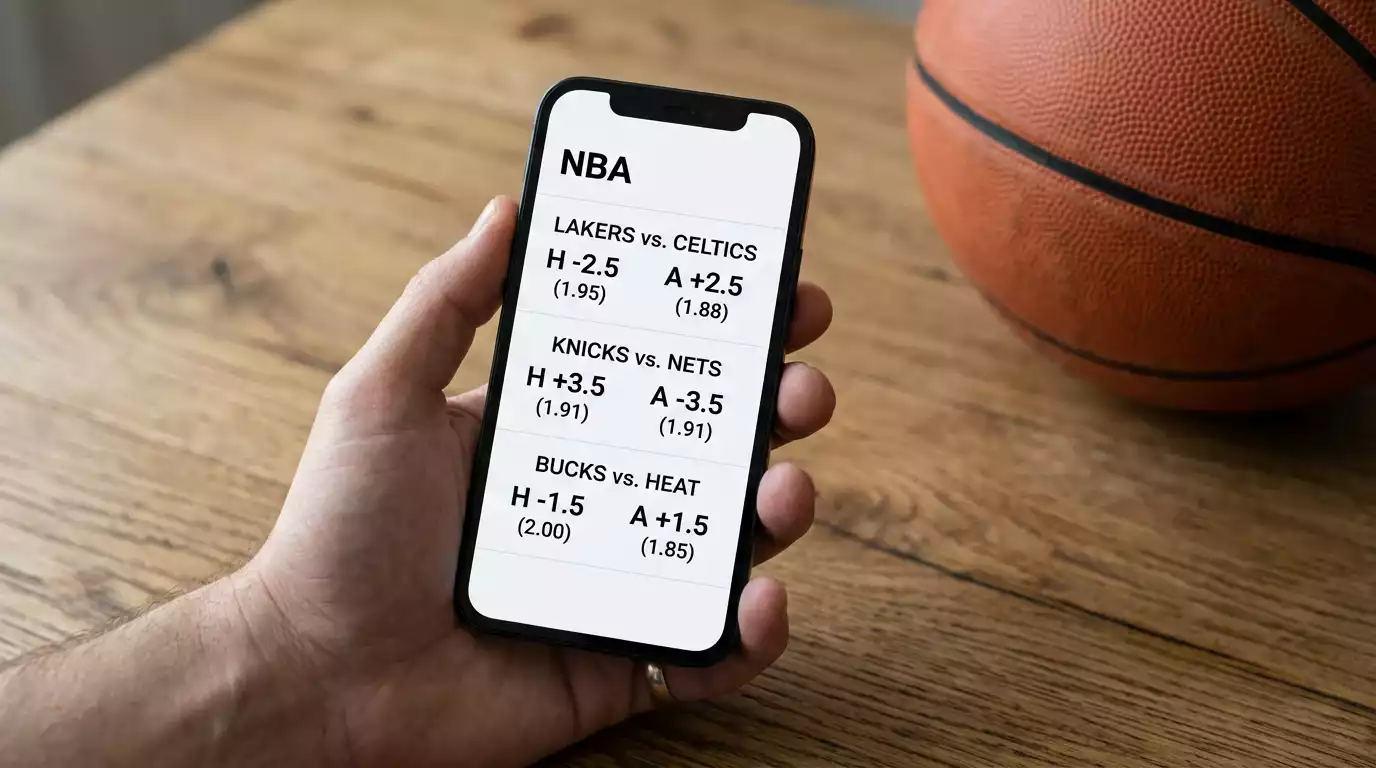
Pushes can only occur on whole-number lines. A spread of -5.0 allows a push; a spread of -5.5 does not, because no basketball game can be decided by exactly 5.5 points. This is why half-point lines exist — they eliminate the push entirely, guaranteeing that every bet resolves as a win or a loss.
The frequency of pushes in basketball is lower than in American football, where key numbers like 3 and 7 concentrate a large percentage of final margins. In basketball, the wider range of possible margins dilutes the probability of any single number occurring. A spread of -5 might push in roughly 3 to 4% of games, compared to 6 to 7% for key football numbers. Still, across hundreds of bets per season, pushes accumulate — and how they’re handled in your betting strategy matters.
The basketball betting market is valued at $8.7 billion globally, and the mechanics of pushes directly influence how that market is structured. Bookmakers prefer half-point lines because pushes create operational complexity (returning stakes, adjusting accumulator payouts) and reduce their hold percentage. When a bookmaker does offer a whole-number line, it’s usually because the half-point line would cross a key number that changes the market dynamics significantly.
Half-Points and Why Bookmakers Use Them to Eliminate Pushes
There’s a reason you see -4.5 far more often than -4 on your NBA betting slip, and it has nothing to do with analytical precision. It’s about the bookmaker’s business model.
Half-point lines ensure every bet resolves decisively. If the spread is -4.5, a four-point victory means the underdog covers; a five-point victory means the favourite covers. No ambiguity, no refunds, no disruption to accumulator structures. For the bookmaker, this simplicity reduces operational friction and increases the percentage of bets on which they collect the vig.
The strategic implication for punters is that the half-point itself has value. Moving from -4 to -4.5 or from -4 to -3.5 changes the mathematical expectation of the bet. In basketball, where certain margins cluster around key numbers like three, seven, and nine, the half-point’s value varies depending on which number it crosses. A half-point around 3 (the difference between -2.5 and -3.5) is worth more than a half-point around 6 (the difference between -5.5 and -6.5), because more games are decided by exactly three points than by exactly six.
Some bookmakers offer “buy the half-point” options, where you pay a premium in the form of reduced odds to move the line by half a point in your favour. Whether that premium is worth paying depends on the specific number you’re crossing. Around 3 in basketball, buying the half-point is often justified. Around non-key numbers like 6 or 8, the premium usually exceeds the value of the half-point.
What Happens When One Leg of a Parlay Pushes
This is where pushes create the most confusion and, occasionally, the most frustration. The treatment of pushed legs in accumulators varies between operators, and not knowing the rules before you bet can produce unpleasant surprises.
The most common approach at UK bookmakers is to void the pushed leg and recalculate the accumulator as if that leg didn’t exist. A five-leg acca where one leg pushes becomes a four-leg acca at the remaining odds. Your potential payout decreases, but the bet isn’t dead — it continues with the surviving legs.
Some operators, particularly US-facing ones, treat pushed legs differently. At certain sportsbooks, a push in a standard parlay reduces the number of legs but doesn’t void the bet. At others, specific parlay types (like teasers) may treat a push as a loss on the entire ticket. The variation between operators makes it essential to read the specific parlay rules at your chosen sportsbook before building multi-leg bets that include whole-number lines.
The practical lesson: when constructing basketball parlays and accumulators, prefer half-point lines on any leg where a push would meaningfully affect your payout structure. The slight difference in odds between -5.0 and -5.5 is almost always worth the certainty of a decisive outcome. If you must include a whole-number line, know exactly how your sportsbook handles the push scenario before the game tips off.
I’ve adopted a personal rule: any time I’m building an accumulator with four or more legs, I avoid whole-number lines entirely. The probability of at least one push occurring across four or more selections is high enough to make the administrative and financial consequences worth preempting. Half-point lines on every leg means every leg resolves cleanly, and the acca’s structure is preserved regardless of margins.
Does a push count as a loss for ATS record purposes?
No. A push is recorded separately from wins and losses in against-the-spread records. If a team’s ATS record is 30-25-5, the 5 represents pushes — games where the team won or lost by exactly the spread number. Pushes are excluded from win percentage calculations. A team that goes 30-25 with 5 pushes has an ATS win rate of 54.5% (30 out of 55 decisive results), not 50% (30 out of 60 total games).
Can a moneyline bet push in basketball?
In standard NBA and EuroLeague games, moneyline bets cannot push because every game produces a winner — overtime ensures there are no draws. The only scenario where a moneyline bet might be voided (functionally similar to a push) is if the game is cancelled or abandoned before completion, in which case most bookmakers return stakes.
How do UK bookmakers treat pushes differently from US sportsbooks?
The core treatment is similar — stakes are returned on pushed bets. The main difference appears in accumulator handling. UK bookmakers typically void the pushed leg and recalculate the acca at reduced odds. Some US-facing sportsbooks have different parlay push rules, particularly for teasers and promotional parlays, where a push may downgrade or void the entire ticket. Always check the specific terms at your sportsbook.
Published by the Basketball Betting Terms team.