Basketball Handicap Betting: Asian and European Handicaps Explained
 Available in US
If you’ve ever bet on football in the UK, you’ve probably encountered handicap betting without thinking twice about it. Asian handicaps, European handicaps — they’re staples of the Premier League punting experience. But the moment you move those same concepts to basketball, the dynamics shift in ways that catch even experienced football bettors off guard. The scoring volume is different, the margins are different, and the strategic logic changes entirely.
I stumbled into basketball handicap betting in 2018 after years of trading football handicaps on exchanges. The transition was rougher than expected. In football, a one-goal handicap is enormous — it can swing the entire result. In basketball, a one-point handicap is almost meaningless against a backdrop of 200-plus combined points. That recalibration took me an entire season to internalise, and I want to spare you the same learning curve.
Basketball betting is valued at $8.7 billion globally and growing. While the American point spread dominates the conversation, handicap formats — particularly Asian handicaps — offer UK punters structural advantages in specific situations that the standard spread doesn’t provide.
European Handicap: The Three-Way Result
The first time I placed a European handicap bet on basketball, I forgot to account for the possibility of a push. In football, where draws are common, I’d always factor in the third outcome. In basketball, where regulation draws are impossible, I assumed the European handicap would also be binary. It isn’t — and that oversight cost me.
A European handicap adds or subtracts a whole number of points from a team’s score, then settles the bet as a three-way market: home win, draw, or away win with the handicap applied. If the handicap is -5 for the home team, and they win by exactly five points, the result after applying the handicap is a draw. You can bet on that outcome specifically, and it’s priced as a separate selection.
This three-way structure creates a market that’s familiar to UK punters who bet on football. The odds format is the same — three prices for three possible outcomes — and the betting slip looks identical. The difference is that basketball’s higher scoring makes the draw outcome less likely for any given handicap line, since the probability of a team winning by an exact margin is spread across a wider range of possible scores.
European handicaps in basketball are most useful when you want to back a team at a specific margin. If you believe the Lakers will beat the Wizards, but by no more than six or seven points, a European handicap of -5 with the draw option lets you cover the scenario where the margin lands exactly on five. The odds on the draw outcome are typically generous — often between 8.00 and 15.00 in decimal — reflecting the low probability, but one hit justifies several losses when you’re selectively targeting these scenarios.
Asian Handicap in Basketball: Quarter and Half Lines
The elegance of the Asian handicap is that it eliminates the draw. I switched almost entirely to Asian handicaps for my basketball bets around 2020, and the clarity of a binary outcome — win or lose, no third option — simplified both my analysis and my record-keeping.
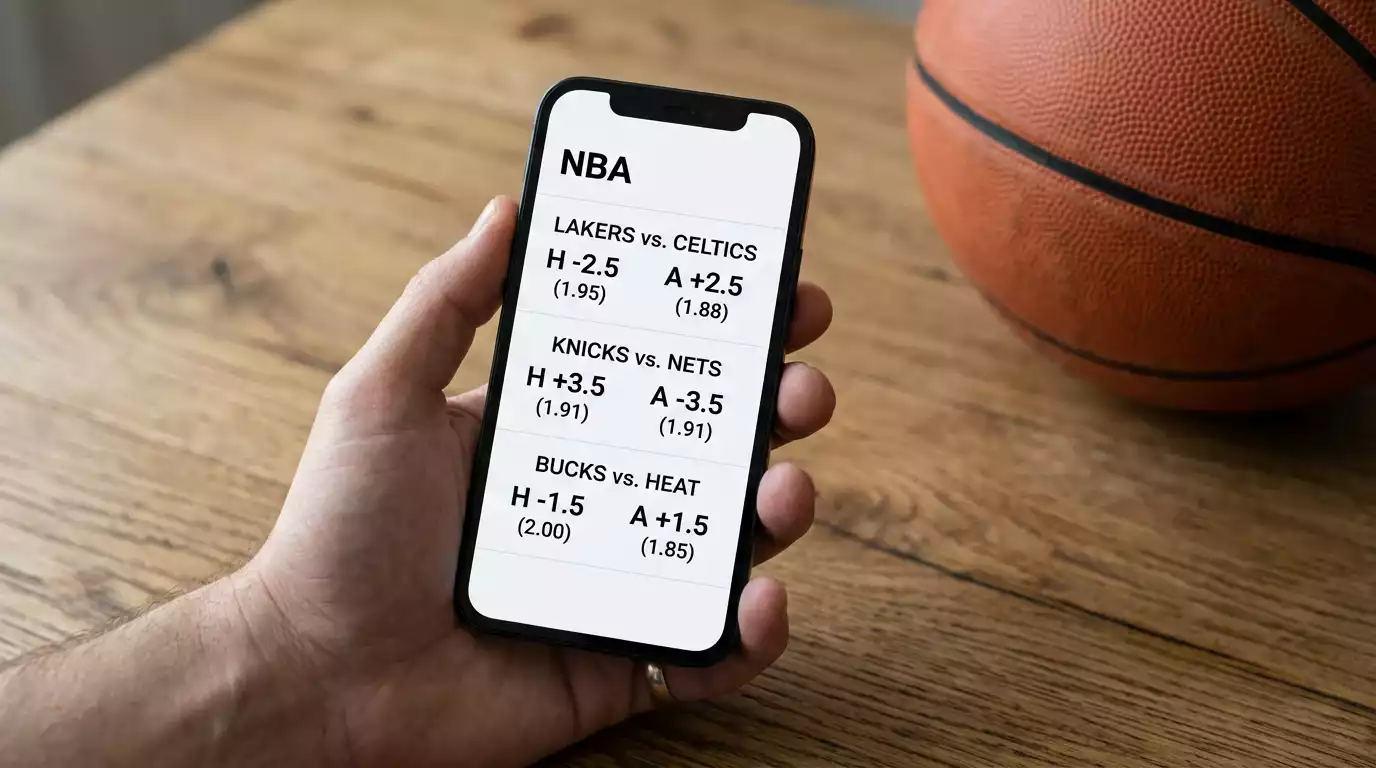
Asian handicaps use half-point and quarter-point lines to ensure every bet resolves as a win or a loss. A -4.5 Asian handicap means the team must win by five or more points for your bet to succeed. If they win by four, you lose. There’s no push, no draw, no ambiguity.
Quarter-point lines add another layer. A -4.25 Asian handicap splits your stake between two lines: half on -4.0 and half on -4.5. If the team wins by exactly four, one half pushes (returned) and the other half loses — you lose 50% of your total stake. If they win by five or more, both halves win. This granularity lets you fine-tune your position in a way that whole-number and half-point lines don’t allow.
North America holds approximately 55% of the basketball betting market, but Asia-Pacific is the fastest-growing region, which partly explains why Asian handicap formats have gained traction in basketball. UK bookmakers now routinely offer Asian handicap lines on NBA games, and coverage is expanding to EuroLeague as well. The format originated in football betting across Southeast Asia, but its application to basketball is natural — the same mathematical principles apply, just at a different scale.
From a practical standpoint, Asian handicap lines on basketball tend to carry slightly tighter margins than European handicaps at the same bookmaker. The two-way market structure is cheaper for the operator to manage — no need to price a third outcome — and that saving often gets passed through to the punter in the form of better odds.
How Handicaps Differ From American Point Spreads
I’ve lost count of the number of times someone has told me that the American point spread and the Asian handicap are “basically the same thing.” They’re similar, yes. But the differences matter, particularly for UK punters navigating between operators that use different formats.
The American point spread is a two-way market with a half-point line, settled at fixed odds that typically hover around 1.91 on both sides (the -110 standard in American odds). If the spread is -6.5, the favourite must win by seven or more. This is functionally identical to a -6.5 Asian handicap in most scenarios.
The divergence appears with whole-number spreads and quarter-point lines. The American system handles pushes differently from Asian handicap conventions. When a US sportsbook sets a spread at -6 and the favourite wins by exactly six, the bet pushes and stakes are returned. The Asian handicap equivalent of -6.0 produces the same result — a push. But Asian handicaps also offer -5.75 and -6.25 lines, splitting stakes across two adjacent numbers, which the American system doesn’t replicate.
For UK punters, the practical implication is this: if you primarily use UKGC-licensed bookmakers, you’ll encounter both formats depending on the operator. Some display their basketball lines as American-style spreads with decimal odds. Others use Asian handicap notation. The underlying maths is the same in most cases, but the presentation and settlement rules around whole-number lines differ enough to warrant checking before you place a bet.
One advantage of the Asian handicap format is the quarter-line flexibility. If you like a team but think the spread is half a point too wide, the quarter-point line lets you split the difference — something the American spread doesn’t offer. Over a large sample of bets, that granularity can improve your risk management by reducing the frequency of binary losses on close margins.
What happens with an Asian handicap of 0 in basketball?
An Asian handicap of 0 — also called a ‘level ball’ or ‘draw no bet’ — means no points are added or subtracted. If the team you back wins, you win. If they lose, you lose. If the game would end in a draw after applying the handicap — which in basketball only happens if the margin is zero, meaning a tie — the bet is void and your stake is returned. Since NBA games cannot end in a draw, the 0 line effectively functions as a moneyline bet with refund protection removed.
Can you get a refund on a handicap bet?
On Asian handicap bets with whole-number lines (e.g. -5.0), a refund occurs if the winning margin lands exactly on the handicap number. Half-point lines (e.g. -5.5) never produce refunds because the result is always decisive. Quarter-point lines (e.g. -5.25) can produce a half-refund, where 50% of your stake is returned and the other 50% wins or loses.
Which UK bookmakers offer Asian handicaps on NBA?
Most major UKGC-licensed operators offer Asian handicap lines on NBA games, including both half-point and quarter-point variants. Coverage is strongest for marquee matchups and playoff games. EuroLeague Asian handicap availability is growing but remains less consistent. Check individual sportsbooks for their specific basketball handicap offerings, as the depth of coverage varies.
Written by the editors at Basketball Betting Terms.